The Penny’s Swan Song: U.S. Ceases Production of Iconic Coin
On November 12, 2025, the United States marked a historic moment as the last penny rolled off the minting line in Philadelphia, closing a chapter on its 232-year history. The penny, a staple of American currency, was once ubiquitous in daily transactions but had become increasingly impractical.
The decision to halt penny production came as the cost to produce the coin soared to 3.69 cents per unit by 2024, as noted in the U.S. Mint’s annual report. This was nearly four times the coin’s value, prompting the U.S. Department of the Treasury to cease its production. Officials also highlighted the diminutive purchasing power of the penny and the shift away from cash in everyday transactions.
Previous efforts to retire the penny included the late Sen. John McCain’s Currency Optimization, Innovation, and National Savings Act in 2017. However, according to experts, the absence of explicit federal guidelines for this transition has left businesses to devise their own strategies for managing cash transactions without pennies.
Some companies, like DSW, have clearly defined rounding policies on their website, rounding up or down to the nearest nickel or dime. Meanwhile, businesses like Deli Towne USA handle it on a case-by-case basis, often rounding to the nearest five or ten cents, according to cashier Melissa Septer. “Most people don’t want the pennies anyway,” Septer remarked.
Currently, the U.S. has over 100 billion pennies in circulation, with the Federal Reserve continuing to distribute them as legal tender. However, Jay Zagosiky from Boston University’s Questram School of Business suggests that a congressional rounding law could help standardize how businesses handle transactions without pennies.
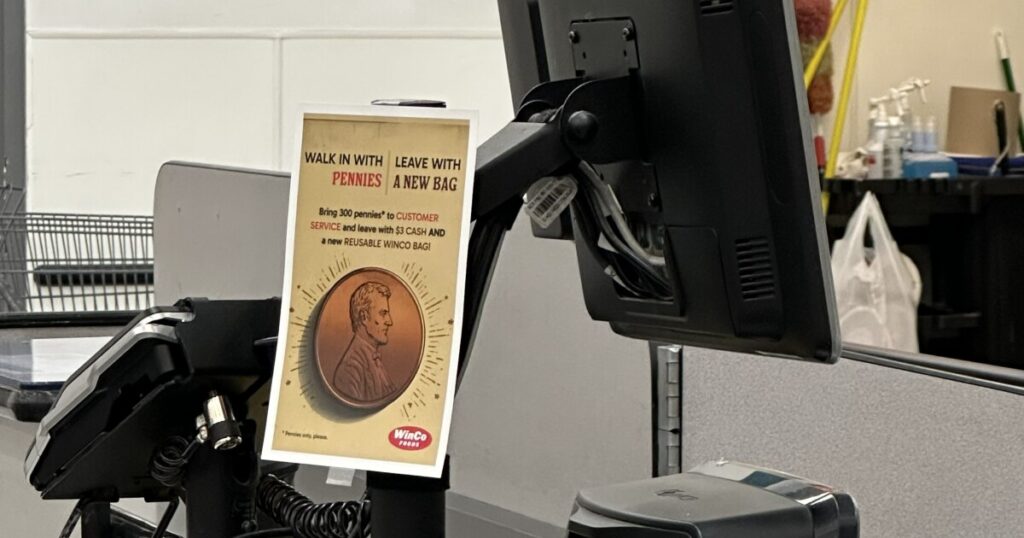
National chains such as Panda Express, PetSmart, and Home Depot have encouraged customers to use exact change or opt for digital payments. Additionally, WinCo Foods has incentivized customers to bring in pennies by offering reusable shopping bags in exchange for 300 pennies at its Northtowne Lane location.
The U.S. is not alone in this move; Canada stopped producing its penny 15 years ago, citing similar reasons. The transition has stirred reactions from the public, including local resident Angelica Miner, who expressed concerns about the surplus of unusable pennies. “It’s just going to be part of our history books,” she observed.