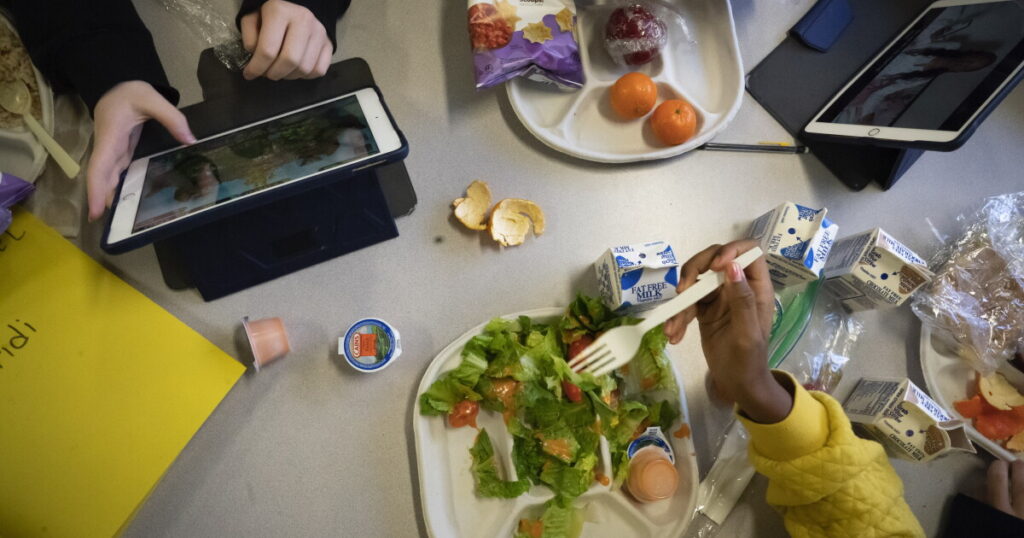
The recent adjustments to the Supplemental Nutrition Assistance Program (SNAP) have raised concerns about the potential impact on school meal programs across the United States. As stricter work requirements come into play, many families risk losing their food benefits, threatening the availability of universal free meals in schools.
Paige Shoemaker DeMio, a senior policy analyst at the Center for American Progress, highlights the interconnectedness of SNAP and school meals. “Anytime we’re hearing about cuts to SNAP or Medicaid, we’re worried about what’s going to be the domino effect of this,” DeMio explains. The changes in SNAP could inadvertently affect children’s access to free meals at school, as families losing SNAP benefits may also lose automatic eligibility for free school meals.
The Center on Budget and Policy Priorities estimates that over a million children have been affected since the One Big Beautiful Bill Act was implemented in July 2025. This legislation has introduced stricter requirements for receiving food assistance, leading to a significant decrease in SNAP participation.
Several schools, including those in San Antonio, Houston, and Miami-Dade County, have already ended their universal free meal programs. Diane Pratt-Heavner from the School Nutrition Association warns that the full impact of these changes might not be fully realized for some time. “This moment in time could potentially be a tip-of-an-iceberg situation,” she cautions.
School Districts Face Financial Challenges
The U.S. Agriculture Department’s Community Eligibility Provision (CEP) allows schools to offer universal free meals if a certain percentage of students participate in assistance programs like SNAP. However, the recent decline in SNAP participation could reduce federal funding, forcing schools to reconsider their budgets. This could mean diverting funds from classroom needs or discontinuing free meal programs altogether.
Erin Bronner, director of child nutrition and wellness for a school district in central Phoenix, shares concerns about the sustainability of their programs. Arizona has experienced a dramatic decline in SNAP participation, affecting over 400,000 people, including 180,000 children. As Bronner’s district prepares to reapply for the provision, she worries, “Due to the dramatic decline in SNAP assistance, the percentage of eligible families [is] not high enough for us to be able to financially sustain operating this provision.”
The “Danger Zone” for Families
Families whose income is slightly above the eligibility threshold for free meals find themselves in a “danger zone,” struggling to afford meals yet not qualifying for any assistance. The school meal application process, often seen as burdensome and complex, does not account for unique family expenses or hardships, leaving many families without support.
Concerns also extend to children of noncitizens, as their parents may hesitate to provide personal information required by the school meal application due to immigration crackdowns. Losing access to free meals could mean families would need to spend nearly $1,000 per student each year, adding to the financial strain many already face.
Debating Universal Free Meal Programs
While nine states currently offer permanent universal free school meals, debates continue over their cost and necessity. Opponents argue that these programs are expensive and unnecessary for families who can afford meals, while proponents emphasize their role in ensuring better educational outcomes and reducing stigma among students.
Sharon Glosson, from San Antonio’s North East Independent School District, supports the benefits of universal free meals, noting, “ It’s open to everyone, and there’s no differentiation between those that qualify for free and reduced price and those that don’t.” However, due to a decline in food assistance, her district has had to limit the availability of free meals, despite ongoing needs among families.
As schools navigate these financial challenges, the conversation about how to best support students’ nutritional needs continues.