This story was originally published by Chalkbeat. Sign up for their newsletters at ckbe.at/newsletters
In Detroit, one student’s daily commute to school involves a complex dance of bus rides and long waits. Elyazar Holiday, a 17-year-old student, navigates through a difficult 20-mile journey across the city, relying solely on an unreliable bus system. His predicament is a reflection of the transportation challenges faced by many students in the area.
The Detroit school district offers limited yellow bus services, particularly for high school students. This leaves students like Holiday, whose families do not have a functioning vehicle, dependent on city buses to reach schools like Davis Aerospace Technical High School. Unfortunately, the public transit system often falls short of their needs, resulting in delays and missed connections.
Hannah Dellinger
/
Chalkbeat Detroit
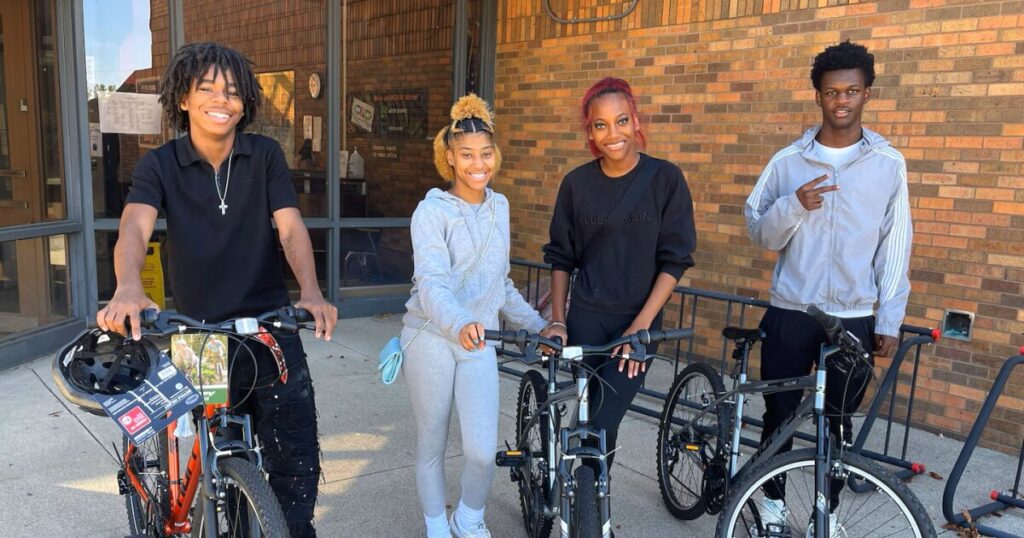
In an effort to tackle this issue, Davis Aerospace Technical High School has adopted an innovative solution: bicycles. Last year, Principal Michelle Davis distributed bicycles to every student, thanks to funding from community donations. This initiative aimed to reduce chronic absenteeism by providing students with a reliable means of transportation.
Students have reported various benefits from the bicycle program. Many of the nearly 100 students at the school stated that the bicycles allowed them to reduce the time spent walking or waiting for buses, thereby reaching school more safely and efficiently. Additionally, the bikes have offered students a newfound sense of independence, enabling them to engage in after-school activities, exercise, and social outings with friends.
“Giving the students bikes is just one problem that we’ve solved for,” Principal Davis explained to Chalkbeat. “What we do intentionally is solve for all of the problems that the kids have, because that has to be our major responsibility.”

Hannah Dellinger
/
Chalkbeat Detroit
As the district looks into expanding this program to other high schools, they have surveyed students to understand the impact of such initiatives. Responses indicated that having access to a bike could significantly improve students’ attendance, as evidenced by the experiences at Davis Aerospace.
Can bikes reduce chronic absenteeism in Detroit?
Chronic absenteeism, characterized by a student missing 10% of the academic year, remains a significant issue in Detroit Public Schools Community District (DPSCD). Various factors, including poverty, health concerns, parental work schedules, and unsafe routes to school, contribute to this problem.
At Davis Aerospace, students like Holiday have found that having a bike helps them overcome some transportation obstacles. The flexibility of biking allows them to catch buses more reliably and provides an alternative mode of transportation when public transit falls short.
Holiday, for instance, noted that his bike enables him to reach bus stops faster, offering a solution when buses are delayed. “With the bike, I can still make up the distance or go to a different street to get on a different bus and still make it there on time,” he shared.
Moreover, the bikes offer a sense of safety for students commuting in areas with declining but still concerning crime rates. “A bike in itself is protection,” Holiday said, highlighting the practical and psychological security it provides.
Younger students, like Myron Dean and Tryve Roberts, have also benefited from the bikes, allowing them to reach school more promptly and independently. The initiative has not only improved their commute but also instilled a sense of freedom akin to what Principal Davis experienced with her first bike as a teenager.
While some research and anecdotal evidence from other states suggest bicycles can reduce chronic absenteeism, the success of such programs has typically been seen in warmer climates. In Detroit, students are advised on bike safety, particularly during adverse weather conditions.
Despite these challenges, the city has about 165 miles of bike lanes, though coverage varies across neighborhoods. As DPSCD continues its efforts to reduce absenteeism, the bike initiative complements a broader strategy to address the unique barriers each student faces in attending school regularly.
Creating a culture of good attendance
DPSCD has made notable progress in reducing chronic absenteeism, with several schools leading the state in this area. At Davis Aerospace, the chronic absenteeism rate fell by more than 14 percentage points compared to the previous year, marking a significant achievement since 2018-19.
Although challenges remain, with over 42% of students still missing too many school days, the culture of attendance at Davis Aerospace is strong. The school implements multiple strategies, such as rewarding classes with the highest attendance and providing resources like free clothing and hygiene products.

Hannah Dellinger
/
Chalkbeat Detroit
The school also offers practical support like a room stocked with free clothing and hygiene products, ensuring students have what they need to attend school prepared. Additionally, there is a washer and dryer available for students to use.
‘A form of freedom’
Beyond addressing absenteeism, the bike program has offered students a sense of freedom and exploration. Principal Davis views the initiative as a loving gesture, providing students with a means to explore their surroundings and gain independence.
Students like Roderic Pippen have discovered new hobbies through biking, and others have used their bikes for practical purposes, such as attending extracurricular programs.
Overall, the initiative has not only helped improve attendance but also contributed to a positive school culture and student well-being, reinforcing the idea that solutions to chronic absenteeism require a comprehensive approach.