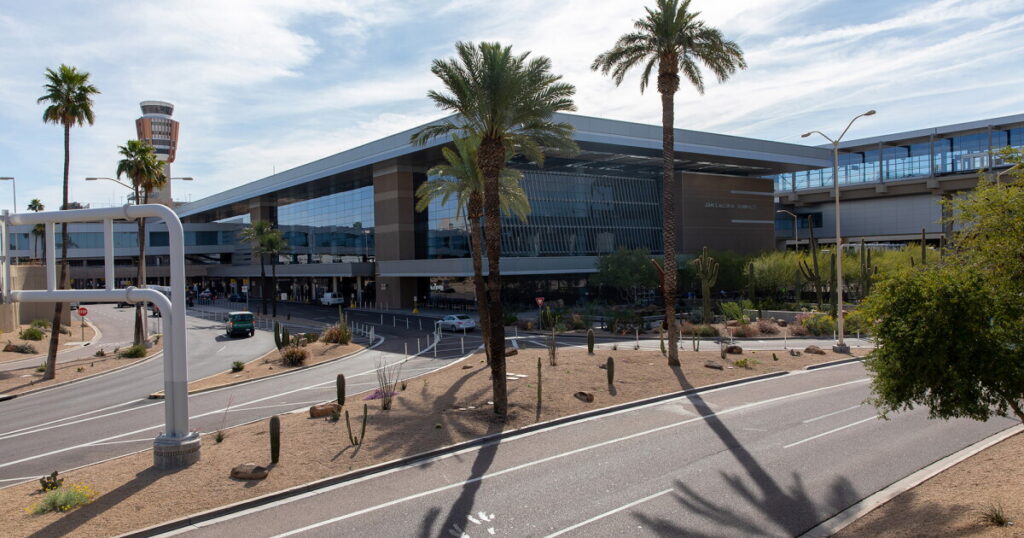
When air traffic controllers across the country suddenly found themselves staring at blank screens last Friday, the ripple effects spread quickly — grounding thousands of flights and stranding passengers from coast to coast. For travelers at Phoenix Sky Harbor and airports across Arizona, the experience raised urgent questions about how rare such an event truly is, and what it takes to recover from it.
The Federal Aviation Administration issued a nationwide ground stop after a cascading telecommunications failure disrupted air traffic control systems at multiple airports. Sky Harbor itself did not experience the communications breakdown, but planes there were still ordered to stay on the ground — a consequence of how interconnected the national airspace system is. The FAA has only issued a nationwide ground stop twice in the past 25 years: once following the September 11, 2001 terrorist attacks, and again in January 2023 due to a technical outage. Friday’s event marked just the third time in a quarter century that all commercial air traffic in the United States was halted.
John Keith, a flight instructor and top FAA safety representative at the administration’s local office, confirmed that Arizona’s communications infrastructure remained intact throughout the crisis.
“There were no radio communications that were lost in Arizona. Other than the feds shutting down the airspace, the communications here at most of the airports — I haven’t heard one in Arizona that had a problem.”
Keith noted that the impact on smaller general aviation airports in the Phoenix metro area was more limited. Training and private flights were able to resume relatively quickly at several locations, including Glendale, Deer Valley, Falcon Field, and Chandler Municipal Airport.
“There was still a lot of training flights able to be conducted. I know Goodyear did shut down. They said, ‘Hey, we’re not gonna let anybody fly.’ That was not the same case at Glendale or Deer Valley or Falcon, they were able to fly. Chandler was also another one that they allowed them to fly,”
Keith said.
The distinction matters because instructional and private flights operate under different protocols than commercial airline flights, which were subject to strict grounding orders that kept thousands of passenger planes on tarmacs nationwide.
Why Commercial Delays Stretched Into Days
Even after the ground stop was lifted, airlines struggled to piece their schedules back together — particularly at major hubs like Sky Harbor. The reason comes down to crew hours. Federal law strictly limits how long pilots and flight attendants can work before they must rest. According to the FAA’s policy for flight attendant labor hours, “In most cases, if you have a scheduled duty period of 14 hours or less, you must have at least nine consecutive hours of scheduled rest after your duty period before you have another duty period.”
Cary Grant, assistant professor of aeronautical science at Embry Riddle’s Prescott campus, explained how even a moderate delay can snowball into a staffing crisis.
“Something like this with the ground stop, the rolling ground stop — that’s the worst one. You get a delay for three hours, and then four hours, and then five hours and your crews start timing out.”
Once crews “time out” — reaching the legal limit on their working hours — airlines must locate replacement personnel before flights can depart, creating a backlog that can persist for days after the original disruption.
How This Compares to 9/11 and 2023
Dr. Michael McCormick has a unique vantage point on events like these. He was the air traffic controller who shut down New York’s airspace on September 11, 2001, and later spent six years in senior executive roles at the FAA. He described the gravity of that decision — and why it is never made lightly.
“Shutting down the airspace is the most significant action you can take and the hardest to recover from. So you have to weigh those factors out.”
On 9/11, McCormick said the calculus was stark:
“They’re using aircraft as weapons. We don’t know how many more aircraft are going to be used as weapons, and the only way that we can disarm the terrorists is to remove the weapons from the sky.”
Friday’s situation was different in nature, but McCormick said federal officials faced a similar kind of uncertainty — not knowing how far the communications failures might spread. That unpredictability, he said, drove the decision to ground all flights.
The 2023 ground stop, by comparison, was considerably less severe. That event disrupted the FAA’s Notice to Air Mission (NOTAM) system — the platform that provides pilots with real-time updates on airport closures, hazardous weather, and other conditions affecting the national airspace. Flights were delayed for roughly 90 minutes before the system was restored with a simple reset.
“The NOTAM shutdown in January 2023 was actually milder. It was not impacting aircraft in the air. There was no loss of communication, no loss of radar surveillance capability.”
McCormick said Friday’s event was more serious because it affected planes already airborne.
“Yesterday’s event impacted aircraft that were actually in the air and flying. So much more of a significant safety issue.”
U.S. Secretary of Transportation Sean Duffy blamed a contractor who was replacing copper wire with fiber optic cable at a remote location, saying the maintenance error triggered the cascading failure of communication systems.
McCormick said the incident underscores just how difficult it is to modernize aging infrastructure without disrupting the system it supports.
“What this highlights is that it’s not an easy task to modernize air traffic control. Because you can’t just flip a switch and turn it off, install new hardware and turn it back on again. You have to keep the system running while you upgrade it.”
Despite the widespread disruption, both Keith and Grant acknowledged that the timing could have been far worse. Keith reflected on what it might have looked like if the failure had struck during one of the busiest travel periods of the year.
“Looking at what went down, I’m not happy it went down, I’m not glad it went down, but I am glad it went down when it did. Can you imagine the melee that would have occurred if this happened on Thanksgiving? It would have been obscene. If it had to happen, I guess the way it happened probably was the best way to find the weakness.”
For more local coverage, KJZZ’s Fronteras Desk has been tracking related stories from the region, including the detention of two men by ICE at Phoenix Sky Harbor Airport, reported by Alisa Reznick, and the reopening of SR89A in Oak Creek Canyon, covered by Greg Hahne and Katherine Davis-Young. The Show also featured an environmental advocate’s concerns about a new Maricopa County air quality rule, as reported by Mark Brodie. In other local news, Kathy Ritchie reports that the Phoenix Veterans Day Parade will follow a new route this year as it marks its 30th anniversary. Additional coverage from the detention of two Argentinian acrobatic performers at Sky Harbor was also reported by Reznick.