On November 22, a significant part of history was delicately transported in Ann Arbor, Michigan, as the University of Michigan relocated a former residence of one of its notable alumni, Raoul Wallenberg. In a meticulous operation, the university commemorated Wallenberg’s enduring legacy by ensuring his former home found a new resting place.
Raoul Wallenberg, who attended the University of Michigan in 1931 as an architecture student, lived for a year in a modest two-story house at 308 E. Madison St. His impactful journey took a pivotal turn during World War II when he used his architectural skills for humanitarian efforts, including the creation of protective “Schutz-Pass” passports to save Hungarian Jews from deportation. By the war’s conclusion, Wallenberg’s courageous actions had saved approximately 70,000 lives.

The University of Michigan is expanding its Central Campus Residential Development, which prompted the need to move Wallenberg’s former abode. This decision not only preserves the historical structure but also clears the way for the addition of 2,300 new student beds when Phase 1 of the development opens next fall.
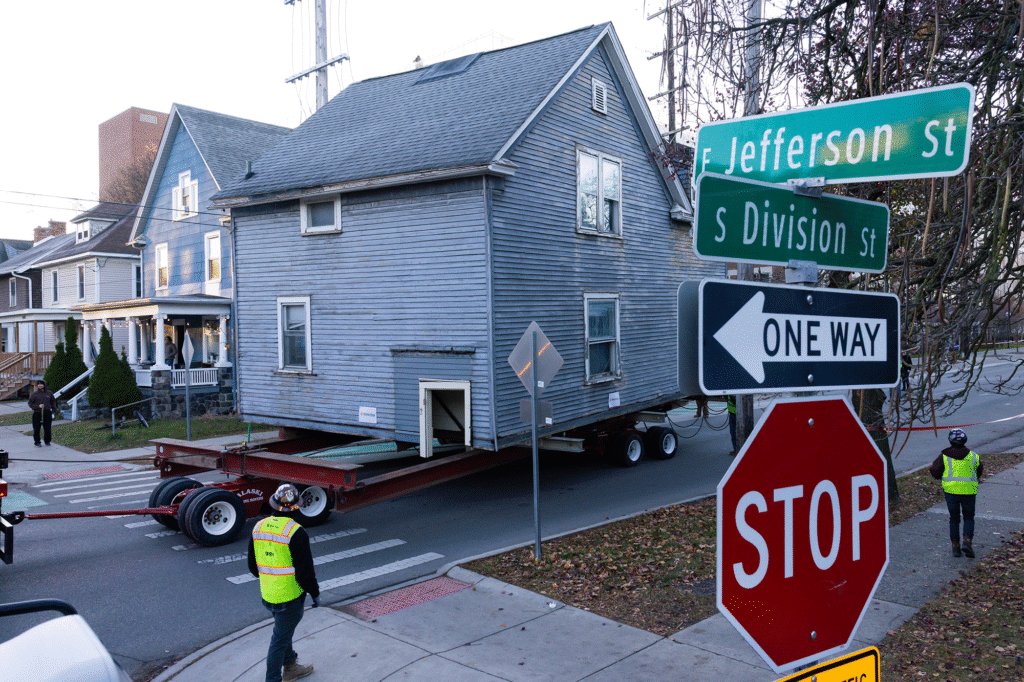
Recognizing the historical significance, the Board of Regents approved relocating the house to a new address at the corner of Jefferson and Division streets. It will now reside next to the former home of famed playwright Arthur Miller, creating a tangible link to the university’s rich legacy.
On the morning of the move, several agencies coordinated the complex task of relocating the two-story, wood-framed structure. Neighbors watched as this piece of history made its way past modern campus buildings, an unusual sight that underscored the careful planning involved.
Readying the Move
The move required extensive coordination, beginning in April when university leaders started working with Walbridge, the company responsible for constructing new residence halls, and multiple utility providers. Trudy Zedaker-Witte, senior project manager with U-M Architecture, Engineering, and Construction, noted the house had been used for student housing but needed attention to facilitate the relocation.
“Once we found out it was Wallenberg’s house, we immediately started making the plans to get this moved so we could save it,” Zedaker-Witte explained. The university’s planning included choosing a weekend free from major university events to minimize any disruptions.
Before the move, on-site preparations involved disconnecting utilities and removing the chimney. The house’s robust structure required minimal bracing for the two-block journey. A new basement foundation awaited its arrival at Division Street.


Relocating History
Tasked with moving the historic structure, Walbridge enlisted Talaski Building Movers, led by senior project manager Mark Corey. The house was initially lifted from its foundation with steel beams providing support under the first-floor structure.
ABOUT THE Wallenberg house
- Structure: Two-story, wood-frame house
- Height: 25 feet, 5 inches
- Weight: 54,000 pounds
- Size: 1,920 square feet
- Who helped with the move: Numerous U-M departments, Walbridge, Talaski Building Movers, city of Ann Arbor, AT&T, Comcast, DTE, Everstream
Using hydraulic systems, the team pulled the 54,000-pound house onto a set of wheels. The streets were closed, and utilities were temporarily moved to facilitate the journey. “Most of these utilities were moved live,” Zedaker-Witte explained, highlighting the precision needed for the operation.
At precisely 7:43 a.m., the house embarked on its slow journey, navigating the streets with care and arriving at its new location in under an hour. The move was executed without any issues, and the house was securely placed on its new foundation.
A New Life
With the house safely settled, it will be prepared for winter. The university now faces the task of deciding on preservation efforts. “The university has a sense of history and preservation,” Zedaker-Witte emphasized, reflecting on the importance of maintaining structures for future generations.
Mark Corey of Walbridge expressed pride in contributing to the university’s projects: “Whether it’s moving a historic structure like Wallenberg, restoring campus buildings, or building for the future, it’s great to be part of it.”