Breakthrough in Leukemia Treatment with FDA Approval of New Drug
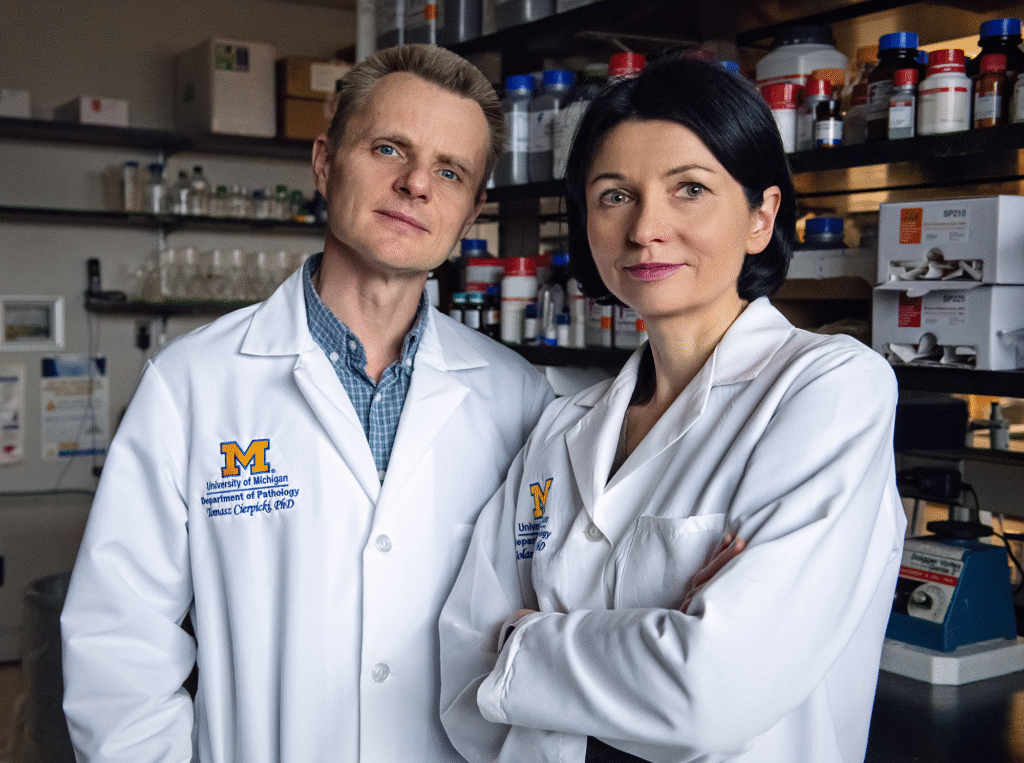
In a significant advancement for those battling acute myeloid leukemia (AML), a new drug provides hope for patients suffering from this rare and aggressive cancer of the bone marrow and blood. This innovation comes from the dedicated research efforts of professors Jolanta Grembecka and Tomasz Cierpicki, who have developed a promising treatment option for individuals with limited alternatives.
KOMZIFTI™ (ziftomenib) stands out as the first oral therapy taken once daily for patients with relapsed or refractory NPM1-mutant AML. The U.S. Food and Drug Administration recently approved this medication, marking a pivotal moment in cancer therapeutics.

The discovery of this groundbreaking drug was achieved through collaboration between Grembecka, Cierpicki, and Kura Oncology. The commercialization and further development of ziftomenib are being carried out by Kura Oncology and Kyowa Kirin.
“Acute myeloid leukemia is a very aggressive blood cancer with poor clinical outcomes,” explained Grembecka, who is also the Richard and Susan Rogel Professor of Cancer Therapeutics. “Seeing our pioneering work on menin inhibitors evolve into an FDA-approved treatment for leukemia patients is extremely rewarding. It is remarkable to witness the direct impact of our research, which resulted in a drug that benefits leukemia patients. This is an achievement we could only dream of, and now it’s a reality.”
In association with the College of Pharmacy, researchers like Duxin Sun contributed to the foundational discoveries that led to the development of KOMZIFTI. These findings were licensed to Kura Oncology in 2014, facilitated by Innovation Partnerships.
The research team focused on creating small molecule inhibitors to target the protein menin. By disrupting specific protein-protein interactions, these inhibitors promote the transformation of cancer cells into normal white blood cells. This strategy offers a new hope for patients with NPM1 mutations, who have limited responses to traditional treatments.
Cierpicki, a professor of biophysics, shared insights into the scientific journey: “To develop menin inhibitors, we had to pioneer an entirely new area of research — producing the human protein, creating robust biochemical assays, conducting high-throughput screening and solving the crystal structure of menin. We accomplished this at a time when the pharmaceutical industry remained skeptical that targeting protein-protein interactions was even feasible.”
The collaboration with Kura Oncology led to the discovery of ziftomenib, which entered clinical trials in 2019. In 2024, a partnership with Kyowa Kirin was formed to enhance global development and commercialization efforts.
Grembecka and Cierpicki initiated their research at the University of Virginia School of Medicine before transitioning to the University of Michigan in 2009. Funding for their work has been supported by Blood Cancer United, the National Institutes of Health, and the American Cancer Society.
Kelly Sexton, associate vice president for research – innovation partnerships and economic impact, commented on the impact of this achievement: “The achievement of Drs. Cierpicki and Grembecka illustrates how sustained federal support for science, combined with the vital contributions of research foundations, fuels discoveries that positively impact patient lives. This FDA approval highlights U-M’s commitment to translating research discoveries into medical breakthroughs that serve patients and advance the public good.”
Currently, clinical trials are investigating the effectiveness of KOMZIFTI in combination with other therapies for both leukemia and solid tumors.
Cierpicki, Grembecka, and the University of Michigan hold a financial interest in Kura Oncology. The associated technology was licensed to Kura Oncology by Innovation Partnerships.