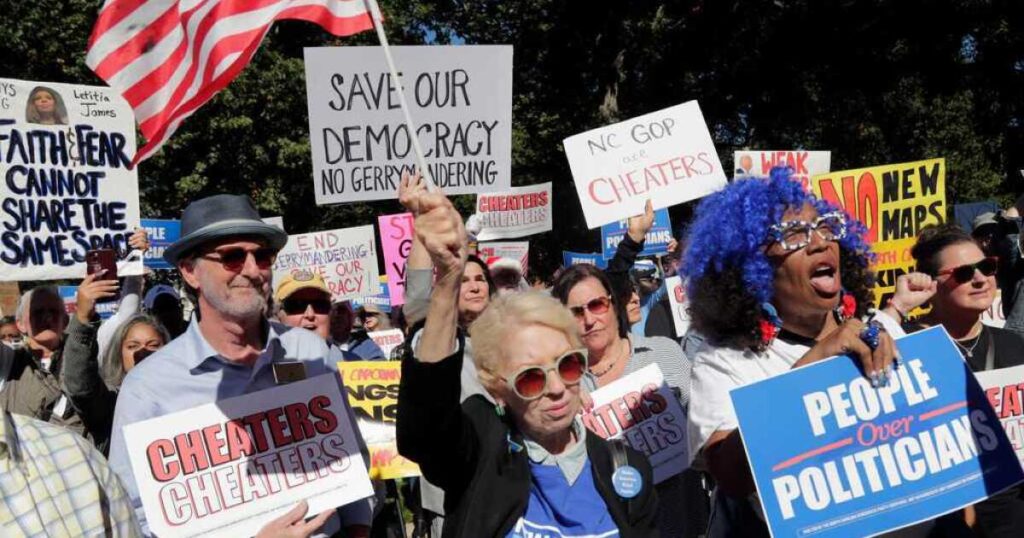
Legal Battle Intensifies Over New North Carolina Congressional Map
Amidst growing controversy, plaintiffs have expanded their lawsuit against North Carolina’s congressional districts to include newly redrawn boundaries affecting eastern areas of the state. This legal amendment to the ongoing Williams v. Hall case challenges the recent changes to the 1st and 3rd Congressional Districts.
The lawsuit, now the first to address the newly revised map, takes issue with the legislative adjustments that Republicans say were informed by political data. These changes are perceived as an effort to solidify the party’s advantage in the 1st District, aligning with former President Donald Trump’s strategy to secure GOP seats for upcoming elections.
Opponents, comprising Democrats and plaintiffs, argue the alterations diminish the influence of Black voters in North Carolina’s Black Belt. They claim the redistricting violates the Voting Rights Act by removing counties with significant Black populations from the 1st District, thus curtailing these communities’ electoral power.
Previously, the Williams v. Hall case targeted allegations of vote dilution in the Triad and Charlotte areas. Legal proceedings began in mid-2023, but a verdict is still pending as the General Assembly modifies the map once more. State legislators have expressed no opposition to the amended legal filing.
According to the plaintiffs, “The 2025 Plan dismantles the Black opportunity district in CD-1 by moving several counties with significant Black populations out of the district and into CD-3, trading them for several primarily white counties, diluting the Black vote in both districts. Under the 2025 Plan, Black voters are extremely unlikely to elect candidates of their choice in either district.”
These sentiments echo concerns voiced by Democrats during the legislative process, as the newly proposed map advanced through committees and was approved by Republican-majority chambers.
Data reveals that the 2024 version of the 1st Congressional District had a voting age population of approximately 40% Black, maintaining a Democratic stronghold since 1992. Under the new configuration, this percentage drops to around 32%, while the 3rd District comprises about 29% Black voters.
The lawsuit further states, “While the newly-configured CD-1 decreases the Democratic voter percentage by approximately 4 points, the (Black voting age population) in CD-1 fell by more than 8 percentage points. In other words, (the) 2025 Plan moved Black voters at a far greater rate than Democrats.”
Plaintiffs are urging the court to rule the new map unconstitutional under the 14th and 15th amendments and Section 2 of the Voting Rights Act. They seek an injunction to prevent its use in upcoming elections and demand a redrawing of the districts.
Responses from legislative leaders, including Senate leader Phil Berger and House Speaker Destin Hall, remain pending. Republican lawmakers defend the map’s legality, stating it was crafted considering political data from the 2024 Presidential Election. Both state and federal courts have historically upheld maps drawn for partisan gain.
Notably, North Carolina’s State Constitution restricts mid-decade redistricting of state legislative districts, although federal law permits congressional redistricting, usually prompted by judicial orders.
Mary Helen Moore
/
North Carolina Newsroom
At a recent press event, House Speaker Hall emphasized, “The constitution gives the legislature the ability to draw these maps. That’s our responsibility to do that. The map that was adopted today was done within the bounds of the law, and that’s the way we’ve done redistricting in this state for about 250 years.”
Currently, only legal action can challenge these maps, as the state’s governor, Democrat Josh Stein, lacks the authority to veto redistricting decisions. The amended Williams case is expected to be among several lawsuits contesting the map.
In a public statement, civil rights advocate Bishop William Barber criticized the new map as “racist” and announced plans for a forthcoming legal challenge.