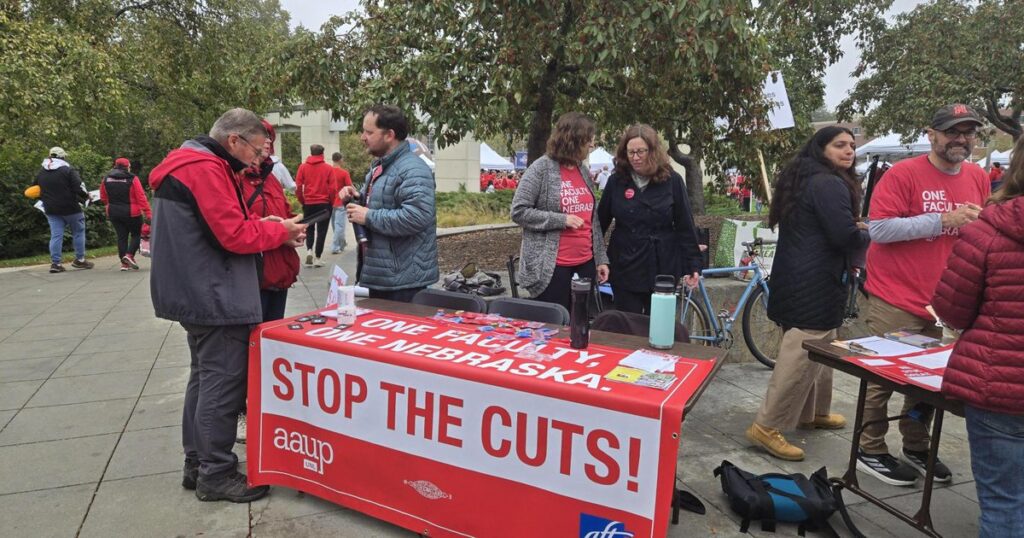
On a lively Saturday morning at Union Plaza, the atmosphere was charged with both excitement and concern. As tailgaters prepared for the Nebraska-Northwestern game, faculty from the University of Nebraska-Lincoln (UNL) rallied to protest proposed budget cuts that could significantly impact the institution.
The UNL chapter of the American Association of University Professors (AAUP) spearheaded the “Stop the Cuts” rally, aiming to spotlight the ramifications of $27.5 million in budget reductions on the university community. Retired UNL employee Jake Kirkland Jr., who served for 30 years, returned to campus to voice his opposition to the cuts.
“It’s going to harm the young people, it’s going to harm the institution, and eventually, somebody’s going to pay for that down the road,” Kirkland expressed, emphasizing concerns over the potential damage to the university’s esteemed status.
The AAUP’s press release detailed that the proposed cuts might result in the elimination of 58 faculty positions and a reduction in teaching roles, which could undermine the university’s core mission. Jennifer Johnson Jorgensen, associate professor and department chair of textiles, merchandising, and fashion design, shared her worries about the potential dismantling of her department. She highlighted the department’s contributions beyond fashion design, such as sustainability research and textile engineering.
“There is a huge need for workers within our industry,” she noted. “It’s one of the largest industries in the state, nation and world, and there’s a workforce behind this. We’ve also found that with our alumni, close to 50% stay in the state of Nebraska, and they have an average salary of $102,000 per year. And so it’s definitely a testament to the value of the skills of our program.” She advocated for considering restructuring as a path to cost-saving without compromising educational quality.
Professor Luis Rosa, from ethnic studies and Spanish, criticized the administration for making budget decisions without faculty input. “What we provide to the state of Nebraska is knowledge,” Rosa stated. He pointed out inconsistencies in how the value of academic programs is assessed, affecting interdisciplinary initiatives that span multiple colleges.
The economic significance of the university is underscored by the NU System’s 2025 Economic Impact Report, which indicates that every dollar invested in the system returns tenfold to Nebraska. The university generates approximately $6.4 billion in economic impact annually, contributing significantly to state and local tax revenues.
Concerns have been raised about dwindling state investment in the university, which could hamper Nebraska’s growth. Rosa emphasized the university’s role, noting the increased administrative costs while instructional spending has decreased.
Earlier this year, the Board of Regents approved $20 million in cuts due to insufficient state funding. State dollars are unrestricted, allowing flexible use by the university. Although revenue from services like dining and housing has nearly doubled since 2010, these funds are restricted in their application. Donations and trust funds have increased over 25 years but are often earmarked for specific projects.
Federal funding, amounting to around $740 million this year, is also at risk, with $88 million in research funding already canceled under the Trump administration. NU President Jeffery Gold warns that up to $285 million more could be jeopardized.
Rosa called for budget decisions to be made collaboratively with input from the university community. “Students and professors should be organizing the university, not administrators that are not part of the University of Nebraska,” he insisted.
In response to budget constraints, the Board of Regents implemented an average 5% tuition increase across the NU system, transferring some financial burdens to students. Hearings for departments potentially affected by the cuts were held earlier in the month, with a final decision expected from the Board of Regents in December.