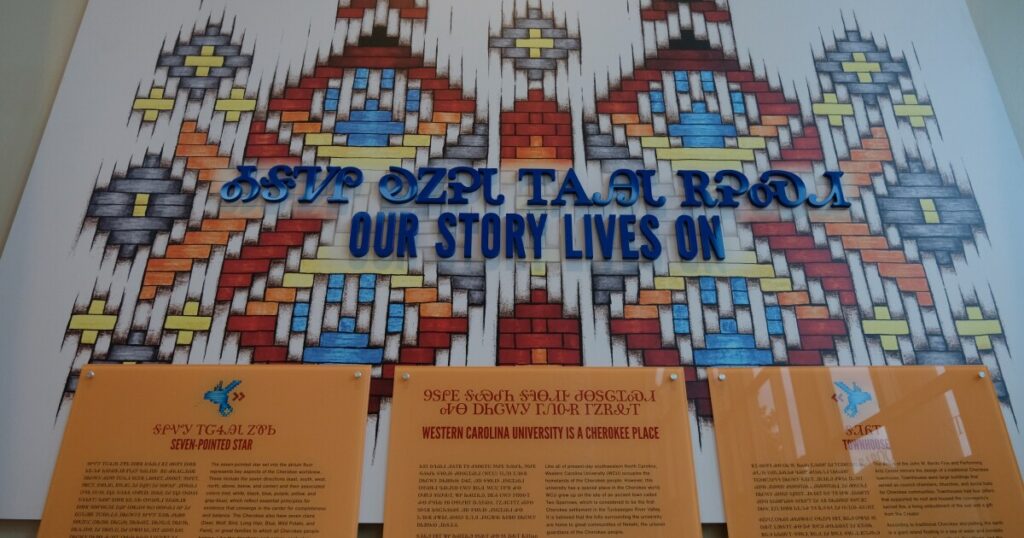
The rich heritage and language of the Cherokee people are now being celebrated through a new exhibit at Western Carolina University. This initiative not only aims to educate visitors but also to honor the deep connections between the university and the Cherokee land it occupies.
On October 21, a gathering of over 40 attendees at the Bardo Arts Center marked the opening of the Cherokee Language and Culture Exhibition. This event was a tribute to the many collaborators who contributed to bringing the exhibit to life.
Denise Drury Homewood, the Executive Director of the arts center, emphasized the significance of the exhibit’s location. “This space is here to honor and elevate the artistic voices of Native peoples through the consistent and ongoing programming here at Bardo Art Center,” Homewood stated. “It’s really a promise, both now and in the future, that indigenous creativity will always have a place here at Western Carolina University.”
The journey of creating this exhibition began eight years ago, sparked by a group of Eastern Band of Cherokee Indians (EBCI) members, university staff, and community leaders. They approached the Cherokee Preservation Foundation, which supported the initial stages with a planning grant.
Throughout the years, the exhibit’s design evolved, ultimately resulting in a permanent installation. It includes panels that showcase the talents of EBCI authors and artists, with descriptions presented first in Cherokee syllabary, followed by English translations.
Tinker Jenks, program director of the Cherokee Preservation Foundation, expressed her enthusiasm for the exhibit’s permanent presence on campus. “There’s a lot of Cherokee students that come to school (WCU) here and being able to see this exhibit here shows that they are important to the school and representation does matter to the students,” she remarked.
In addition to the exhibit, the university has also received a planning grant from the foundation to explore the possibility of placing historical markers at significant Cherokee sites on campus.
The Bardo Arts Center, which opened in 2005, features bilingual signage in both Cherokee syllabary and English. This translation was undertaken by Myrtle Driver, a Beloved Woman of the EBCI, whose work inspired the current project.