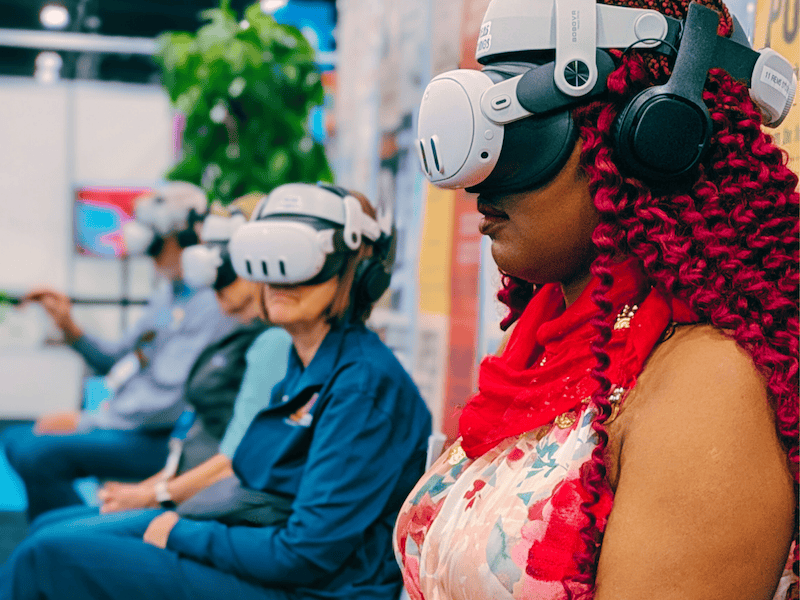
On World Polio Day, a US-based company, REM5 STUDIOS, backed by the Gates Foundation, is spotlighting the significance of vaccines and their life-saving potential. Using innovative virtual reality technology, they’re telling real stories of global health from various locations, including the Democratic Republic of Congo, to classrooms across America.
Brian Skalak, the director of engagement at REM5 STUDIOS, describes his work not in terms of computer code or camera rigs, but in terms of people. His team’s focus lies on health workers delivering vaccines across flooded roads and rivers in the Democratic Republic of Congo, communities in remote villages awaiting protection from polio, and decision-makers in donor countries, thousands of miles away. These stakeholders are all connected and reminded of the importance of reaching every child with life-saving vaccines through the immersive VR experiences created by REM5 STUDIOS.
In collaboration with the Gates Foundation, Rotary International, and other members of the Global Polio Eradication Initiative (GPEI), REM5 STUDIOS has created a series of immersive VR experiences. These experiences bring users face-to-face with the realities of vaccine delivery. Their most recent project, Apporter La Vie – Delivering Life – takes audiences on a journey deep into the Democratic Republic of Congo. Users follow frontline worker Kasongo as he transports vaccines through sweltering heat, torrential rain, and hundreds of kilometers of inland waterways.
Skalak aims to close the distance between different parts of the world with this technology. If you have just ten minutes, VR can create an instant emotional connection, enabling users to really see what’s happening on the frontlines of healthcare and why it matters. It also serves as a bridge between the people funding vaccine campaigns and those delivering them. These VR experiences, filmed with ultra-high-definition immersive cameras, allow users to follow Kasongo’s team as they maintain the so-called ‘cold chain’ – the carefully monitored refrigeration process that keeps vaccines viable.
The VR experience is more than just a novelty; it’s about presence. Users can freely look around, hear the sounds of children playing in distant villages, and watch health workers balancing vaccine crates on small wooden boats. The Gates Foundation, one of the largest funders of vaccine initiatives worldwide, supported both Apporter La Vie and Polio’s Last Mile. Amber Zeddies, the foundation’s Senior Programme Officer for Polio Advocacy and Communications, viewed the project as a powerful storytelling tool that restores urgency, proximity and human clarity to the mission of eradicating polio.
With public trust in vaccines falling sharply in recent years in the United States, REM5’s mission of showing the human impact of vaccines is more relevant than ever. Seeing the faces of families in the Congo who walk for hours just to reach a clinic, you understand what’s at stake. REM5’s VR headsets have traveled primarily to global health and policy events where they’ve introduced thousands of first-time users to immersive storytelling. In surveys, 90% of participants reported an increased commitment to immunisation after watching.
REM5 STUDIOS, with support from the Gates Foundation, is now making the technology available domestically in the US. Anyone with a headset can download a free app onto their device and experience the global fight against preventable diseases. The ultimate goal is to expand the reach of this experience, particularly through community groups, schools, and Rotary clubs.
REM5 is also working with educators to build curriculum content around the VR experience and is in discussion with science museums about potential exhibits. The response from audiences has been profound, emphasizing that VR isn’t just about visuals, it’s about empathy. It helps people connect to stories they may otherwise never encounter, translating into real-world impact.
As an example, Saudi Arabia recently pledged $500m to the global polio eradication effort. While such decisions aren’t driven by a single event, projects like Apporter La Vie play a part in sustaining attention and inspiring action among policymakers and philanthropists. REM5 is now exploring how the same technology can be applied to other health and humanitarian causes.
In a time when public debate around science and health has become polarized, REM5’s approach offers something quietly radical: a way to see, rather than be told. The landscapes may be virtual, but the impact is real. As Skalak said, if a headset can help someone understand that vaccines are part of the story of healthy kids, strong communities, and a fair shot at life, then it’s done its job.