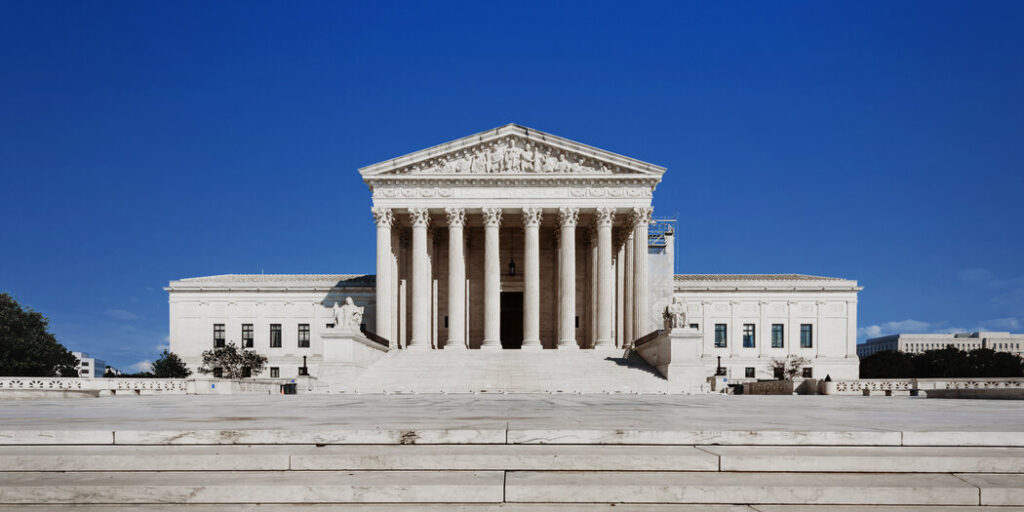
Supreme Court Revisits the Voting Rights Act, Key Provisions Under Scrutiny
The Voting Rights Act, a significant legislative milestone from the civil rights era, was designed to ensure that Americans could exercise their voting rights regardless of race. On Wednesday morning, the Supreme Court deliberated on a case that could potentially dismantle a crucial enforcement mechanism of this law.
In March 1965, the efforts of nonviolent protesters in Selma, Alabama, brought national attention to the struggle for voting equality. Demonstrators faced violent opposition from state police on the Edmund Pettus Bridge, sparking widespread public outrage. This pivotal moment led President Lyndon Johnson and Congress to pass the Voting Rights Act, which prohibited racial discrimination in voting practices. The legislation, hailed as a bipartisan achievement, has been amended to outlaw both intentional and effect-based discriminatory practices.
The enactment of the Voting Rights Act marked the beginning of a “Second Reconstruction,” aimed at fulfilling the promises of the 14th and 15th Amendments. From its inception, the act transformed political landscapes from local to federal levels, significantly broadening voter participation and protecting against discriminatory voting laws. The act empowered voters of color to contest rules that impeded their ability to elect candidates of their choice. Both major political parties have supported the act over the years, with its last reauthorization occurring in 2006 under Republican leadership.
Despite its achievements, the Voting Rights Act has faced challenges over time, particularly from the Supreme Court. In 2013, the Court’s decision in Shelby County v. Holder invalidated Section 5 of the act, which required specific states, primarily in the South, to seek federal approval before changing voting procedures. Justice Ruth Bader Ginsburg’s dissent famously compared this decision to “throwing away your umbrella in a rainstorm because you are not getting wet.”
Subsequent to the removal of Section 5, numerous states have enacted laws complicating the voting process. The Brennan Center reported an increase in the racial turnout gap, with disparities reaching 18 percentage points in the 2022 midterms, most notably in areas previously governed by Section 5.
Although Section 5 was eliminated, the Supreme Court maintained that Section 2 remained a potent enforcement tool for the Voting Rights Act. The current case, Louisiana v. Callais, questions the constitutionality of Section 2 itself, posing a significant challenge to the future of the act.
The controversy centers on Louisiana’s congressional map drawn by Republicans in 2020, which diluted the voting power of Black residents. Despite representing a third of the state’s population, Black voters had influence in only one of six districts. A court ruling under Section 2 struck down this map, prompting legislative revisions. However, a group of white voters later contested the revised map, claiming it infringed upon the Equal Protection Clause of the 14th Amendment by emphasizing race.
Louisiana contends that states should not be required to consider race when drafting electoral maps, presenting a unique interpretation of the 14th Amendment that could undo civil rights protections. This perspective threatens to revert to an era of racial exclusion from political representation, challenging the very necessity of the Voting Rights Act.
Instances of racial discrimination in voting persist, as evidenced by court findings of intentional discrimination and vote dilution in Louisiana and other states. During the Supreme Court arguments on Wednesday, some justices appeared open to either significantly limiting or completely removing Section 2. Eliminating this provision, as outlined in the Brennan Center’s friend-of-the-court brief, could create confusion in the redistricting process nationwide just before a national election.
The battle for equal voting rights has always required collective action. In 1965, it was the bravery of Selma marchers that paved the way for change. Today, ensuring the protection of these rights calls for renewed commitment from all Americans to uphold our constitutional values.