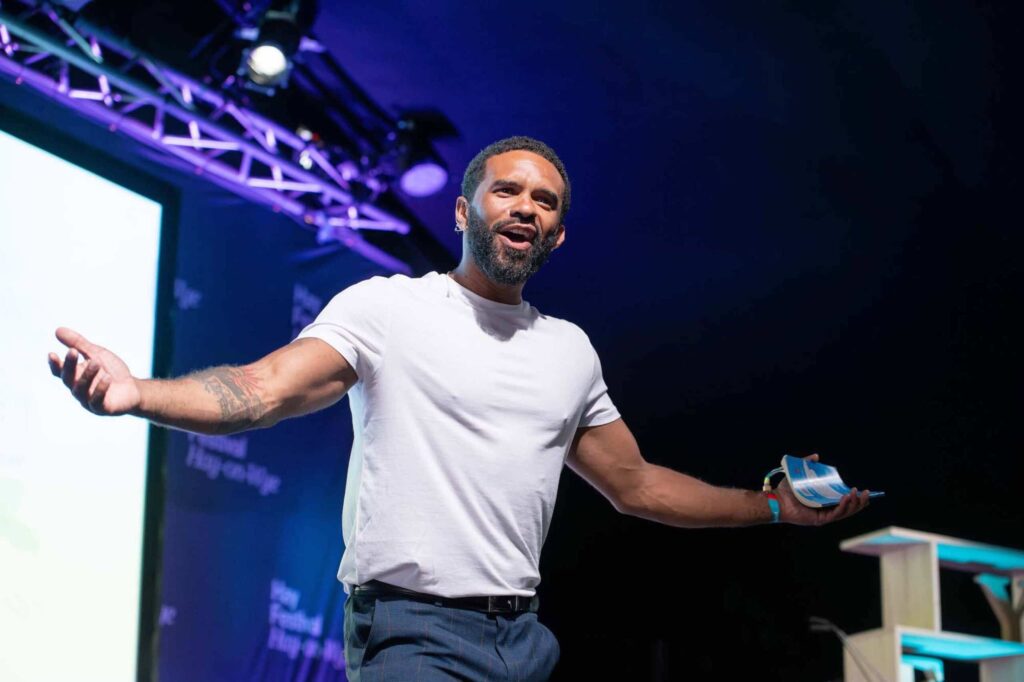
Alex Wharton, a Welsh native who grew up in a small mining town, has embarked on a remarkable journey from interpreting rap lyrics to writing engaging children’s poetry. His journey is a testament to how language and reading can open up worlds of imagination and transform young lives.
Born in the post-industrial mining town of Pontypool in south Wales, Wharton was transported to far-off places through his eclectic reading habits. As a child, he enjoyed vibrant comics and thick general knowledge books that introduced him to various global cultures. As a teenager, he explored the world of rhythm and rhyme through the lyrics of rap artists such as Outkast, Lauryn Hill, and Talib Kweli.
“I often say that I didn’t start reading poetry until I was an adult. But in retrospect, studying those lyrics as a teenager was indeed my way of engaging with poetry,” Wharton reflects. Now serving as the Children’s Laureate for Wales, Wharton combines words and rhythm to create compelling stories and poems for children and adults alike.
Wharton’s poetry style is characterized by a fluid, musical pulse. One of his poems, ‘I Don’t Want to Write a Poem,’ exemplifies this: “I need fizzy-dizzy-disco words that bounce along a beat.” The poet believes in power of language to forge connections and foster a positive environment. Wharton’s work encourages children to see how literature and language can significantly improve their lives.
Reading plays a critical role in a child’s success, Wharton notes. When reading is made interesting and relatable, children are more likely to develop the habit themselves. This is especially crucial given that recent studies suggest less than half of parents find reading to their children enjoyable. Wharton believes in overcoming this reluctance and instilling a love for reading early on, setting the stage for a lifelong affinity for learning.
Wharton asserts that fostering positive associations with reading from a young age often leads to a lifelong love for literature. “If children enjoy reading during their formative years, they are more likely to continue this habit into their teenage and adult years, recognizing the value of reading to their own children,” he says.
Wharton does not limit his audience while writing his children’s poetry books. His works, like ‘Doughnuts, Thieves and Chimpanzees,’ are meant to engage not just children, but people of all ages. “I don’t write for children, I write for everyone, excluding no one.” he clarifies. “This way, my work can be entertaining for librarians, teachers, parents, guardians, and of course, children.”
Wharton views poetry not only as a source of entertainment and education but also as a tool for cognitive development. Memorizing poetry strengthens brain connections and enriches vocabulary, offering a deeper understanding of the world. His interactions with children, who he encourages to write their own poetry, are a constant source of surprise and inspiration for him. He describes witnessing “small but powerful ripples” as children discover their potential to create with words.
“You can see it in their eyes, the wheels turning, as you transport them into a world where anything is possible. That realization of their connection to literature and language and the boundless scope of their creativity is incredibly powerful,” says Wharton.