Nebraska’s cornfields are experiencing a banner year, thanks in part to proactive measures by farmers who have expanded their planting areas to counteract pest challenges. This strategic approach has paid off, resulting in a bountiful harvest of Nebraska-grown corn.
While some Pawnee corn is also cultivated in Oklahoma, the growing season there has not been as favorable. Echo-Hawk noted that Oklahoma growers strive to surpass their Nebraska counterparts but have yet to do so. She remarked, “The Nebraska soil is what the seeds remember.”
Corn and Family Ties
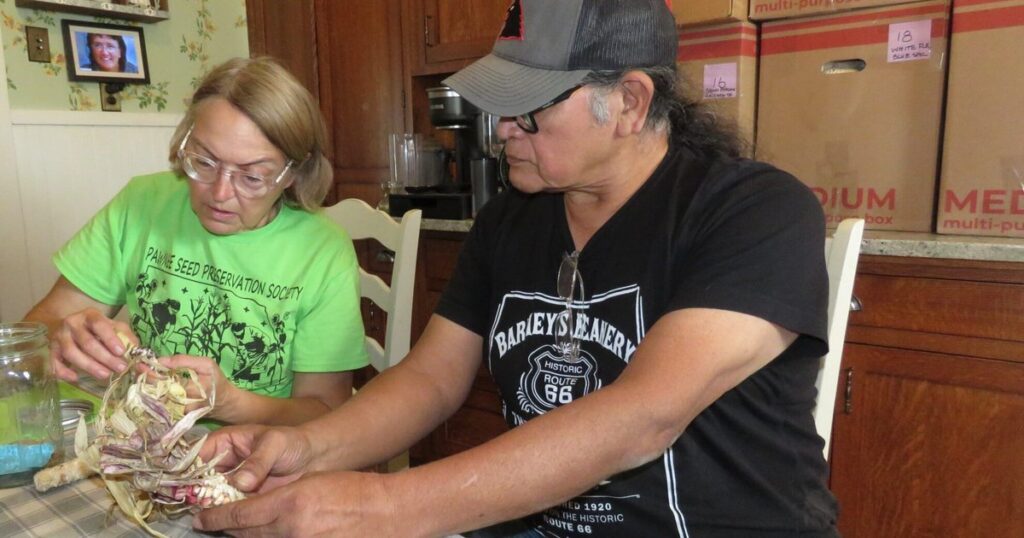
Discoveries like the red sunset corn reflect both innovative varieties and deep-rooted family connections to ancestors who preserved seeds for future generations. O’Brien observed that the red sunset and eagle corn kernels she keeps are larger than usual. As she and Howell examined these kernels, she remarked, “Every year, we have something that looks different. It was close to eagle corn, but that told me it’s a new variety growing,” and mentioned that the original seeds of this type of eagle corn came from Geraldine.
Howell shared that his mother, Geraldine, had a collection of seeds that was akin to a treasure chest, passed down from his great-grandmother. “We got to look at them (seeds). It was her little secret. She thought maybe … this will come back,” he said. Geraldine passed away in 2012, having witnessed some successful restorations of Pawnee corn.
Echo-Hawk recalled bringing new seeds to Geraldine for planting in her garden, enabling her to stock her pantry, which she described as their ultimate goal.
Among the recovered Pawnee corn varieties, blue corn has advanced to the point where it can be utilized for food rather than solely for seed stock. Echo-Hawk determines which seeds from various varieties are sent to Nebraska growers for planting each spring.
Reflecting on the collaboration between the Pawnee and Nebraska growers, Howell mused that his ancestors would likely be astonished at both the resurgence of traditional corn varieties and the emergence of new ones. “They’d probably be surprised about what they have grown and also the new things (varieties),” he commented.