When the sky opened up over the Grand Canyon on August 29, 2026, it didn’t just rain — it raged. What began as an overcast morning hike turned into a life-or-death scramble, and for three men caught in a narrow stretch of canyon, it became fatal.
Northern Arizona’s monsoon season brings violent, fast-moving storms each summer, but the August storm that tore through the Grand Canyon was extraordinary even by those standards. Floodwaters surged down Bright Angel Creek with enough force to sweep people off their feet, destroying infrastructure and stranding dozens. Writer Scott Thybony tracked down one of the survivors to hear what that morning was really like, as part of his Canyon Commentaries series produced by KNAU Arizona Public Radio.
The Hopi people, who have lived in mesa-top villages across this region for centuries, recognize the difference between life-giving rain and destructive rain. Delfred Leslie, a traditional Hopi leader, explained it plainly:
“A gentle rain is preferred by everyone. A gentle, soaking rain. Thunder rain is a fast rain with lightning and thunder. It’s violent, destructive and lasts less than an hour. . . . It’s a worry to Hopis. There’s something not right in the village. Those rains come and remind you to straighten up. Thunder rain is ominous.”
That is exactly the kind of rain that fell on August 29.
Caught in the Storm
Tom Monroe, a Flagstaff resident, was hiking that morning with friends Dawn Dyer and Michael Harrison. The group set out from the North Rim around 9:00 a.m., bound for Cottonwood Camp. The sky was overcast but another hiker had passed along word that the forecast was trending toward milder conditions. “We were thinking, ‘Cool, it’s going to clear up,'” Monroe recalled.
The three hikers descended the North Kaibab Trail through layers of crossbedded sandstone and into the burn scar left behind by the 2025 Dragon Bravo Fire, which had destroyed the Grand Canyon Lodge. Then the sky collapsed on them. Monroe described it as “it unleashed on us, just started dumping.”
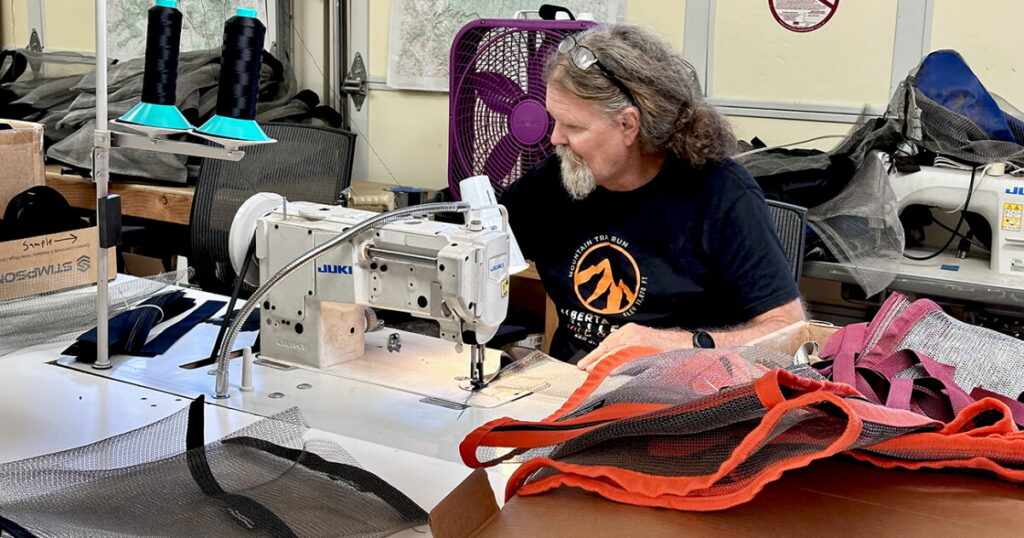
Waterfalls poured off the canyon walls, blackening the rock with ash. The trail transformed into a muddy river. Monroe paused recounting the story — he was at his Flagstaff shop sewing steel-mesh food storage bags when Thybony visited — and described the full force of what hit them: “We had lightning, thunder, falls coming over the canyon walls. It was gnarly.”
The group scattered to find whatever shelter shallow overhangs could offer. Rocks the size of basketballs washed off the canyon sides. Lightning struck a cliff directly above one hiker farther down the trail.
Michael Harrison, who had been out ahead by about a quarter mile, made the call to turn back — only to find a four-foot wall of water tearing across the wash in front of him. The flood had cut the trail entirely. He scrambled up a loose slope, grabbing tree roots to avoid being swept away, and waited for the water to drop enough to cross.
Once reunited, the group faced a clear decision. “We’re like, ‘Holy cow! What are we going to do?'” Monroe said. The answer was to get out. “Lightning was going off right above us,” he said, as boulders kept crashing down. “It was really, really noisy, especially the hail. Lightning, thunder, hail — it was loud.”
They made it back to the rim safely.
A Deadlier Wave
Others were not so fortunate. A second, more intense downpour later that afternoon sent a flash flood racing down Bright Angel Creek, raising the water level five feet in just ten minutes. Three men were caught in a sheer-walled section of the canyon known as The Box — a narrow passage with no escape — and were swept away by the surge.
By 2:30 p.m., floodwaters had reached the Phantom Ranch area at the canyon’s inner gorge. Eighty-two people were left stranded by the rapidly rising water and had to be evacuated by helicopter. When the thunder rain finally stopped, the damage it left behind was extensive: much of the Transcanyon Waterline had been destroyed, footbridges were gone, and large sections of trail were buried under rockslides.
The monsoon’s reach extended well beyond the canyon. Record rainfall across the Four Corners region continued with almost no break until early November, bringing road closures, forced evacuations, and aerial rescues to communities throughout the area. The Grand Canyon Superintendent Ed Keable announced his retirement in November, as the park continued to assess the season’s toll. Audio production for the original Canyon Commentary was handled by Adrian Skabelund.