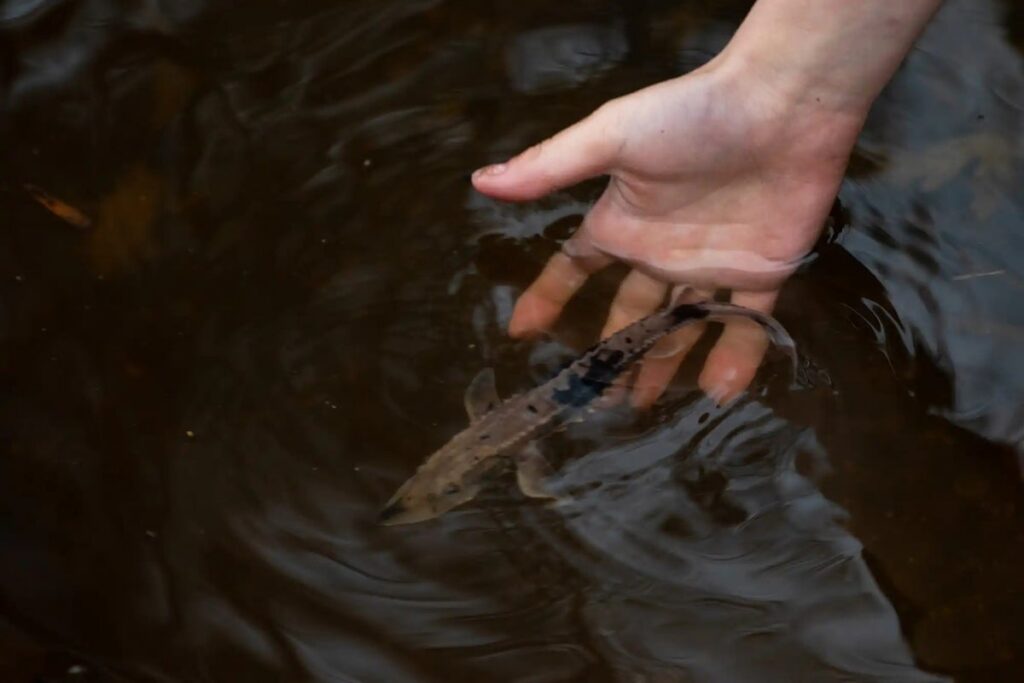
This month saw a significant step forward in the ongoing mission to bring back the ancient lake sturgeon to Lake Superior’s headwaters. The return of this giant fish species to the St. Louis River marks a pivotal moment in a restoration effort spanning several decades.
More than 50 years after lake sturgeon disappeared from the St. Louis River, experts from various organizations released hundreds of young sturgeon into the river. These fish were raised from eggs in secure environments, marking a new chapter in a restoration journey that began in the 1980s (source).
This initiative, involving state, federal, tribal partners, and the Great Lakes Aquarium in Duluth, is unique as it’s the first time sturgeon were reared in water sourced directly from the St. Louis River. This approach is believed to enhance the likelihood of the sturgeon returning to the river to spawn in the future.
“Sturgeon, they grow a lot, they see a lot and they know a lot,” said Eric Torvinen, fisheries biologist for the Fond du Lac Band of Lake Superior Chippewa. “That’s why they’re such an important fish to us and such a unique fish to keep around.”
Giant, ancient fish
Lake sturgeon, the largest fish in Minnesota, can grow up to 7 feet long and weigh over 200 pounds. These creatures, known for their longevity, can live for several centuries, with some studies suggesting a lifespan of up to 400 years.
Unlike typical fish, sturgeon are covered in bony plates. “When you look at them, they look like sharks,” said Jay Walker, Executive Director of the Great Lakes Aquarium. Sturgeon use their barbels to locate food, which they then consume with a mouth that vacuums it up.

Sturgeon have existed since the dinosaur era, surviving multiple extinctions. However, human activity led to their disappearance from the St. Louis River in the mid-1900s due to habitat degradation and pollution.
Efforts to rehabilitate the river have resulted in cleaner conditions, prompting the Minnesota DNR to begin restocking initiatives in the 1980s, followed by the Fond du Lac Band in the 1990s.

In 2011, natural reproduction was observed in the lower river, but the population remains non-self-sustaining. The Minnesota DNR, along with partners, has adopted a new strategy to raise sturgeon in river water, hoping to improve spawning rates.
Young sturgeon imprint on the water they grow in, a process believed to guide them back to spawn. “There’s a lot of research that shows that the sturgeon imprint on the water they’re raised on within the first 30 to 45 days of their life,” said Miranda Rinne, curator of aquatics at the Great Lakes Aquarium.

Previously, sturgeon were raised in well water or water from other regions, possibly affecting their return to the St. Louis River. The hope is that being raised in local water will encourage these fish to spawn in their native river.
By early November, the sturgeon were ready to be introduced to the wild. Each fish was tagged for future identification, allowing researchers to study them long after their release.
‘Have a good life!’
On November 3, biologists released the sturgeon into different points of the river. Ingrid Johnson of the DNR sent off the fish with a hopeful, “Have a good life, little buddies!”
Angela Piket, who helped raise the sturgeon, expressed hope for their survival: “We babied them so much over the last six months. So just to just put them out in the river and hope Mother Nature does its thing …”
Research indicates a high survival rate for sturgeon of this size. Hundreds more sturgeon raised in various waters were also released, continuing a cultural legacy for the Fond du Lac Band, where sturgeon are esteemed for their wisdom.

The $1.6 million project plans to open a new sturgeon exhibit at the Great Lakes Aquarium in 2027, aiming to raise awareness of the conservation efforts. With state grants, an indoor facility will be built to rear 3,500 sturgeon annually.
“This is not going to be just an endless stocking campaign,” said Wilfond. “We do expect these fish to recover, to be able to reproduce on their own, to become sustainable in the St. Louis River.”