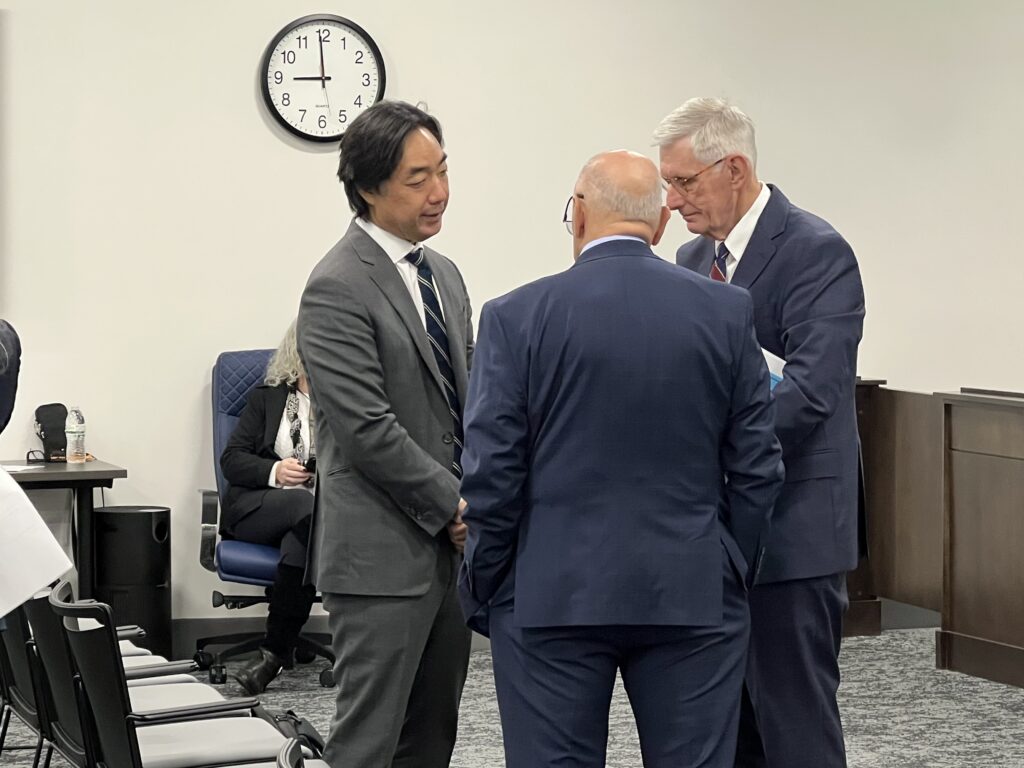
A new Major League Baseball stadium on the Las Vegas Strip is on track to open in April 2028 — but questions about who will pay for key parts of the project have put a spotlight on Bally’s Corp., the company responsible for building the main public entrance. At a Nevada Gaming Control Board hearing, regulators pressed Bally’s chairman directly about whether the company can deliver on its commitments.
The $2.1 billion A’s stadium development involves multiple parties sharing responsibilities across a 35-acre site. Bally’s is tasked with constructing the northwest plaza entrance — the primary access point from the Strip. During a Thursday morning hearing in Las Vegas, Gaming Control Board Chairman Mike Dreitzer confronted Bally’s CEO Soo Kim about the company’s financial capacity and dedication to the Las Vegas project.
“I have some significant concerns because in what is probably one of the most iconic corners and one of the most iconic cities in the world, we seem to be sort of the bottom of the barrel here relative to what’s going on,”
Dreitzer said.
The hearing was originally called to review Bally’s purchase of a European online gaming company. But regulators used the opportunity to press Kim on the Las Vegas stadium obligations, noting the company is simultaneously developing major casino resorts in Chicago and New York.
What Bally’s Is Promising
Kim told the board that Bally’s is committed to covering an initial $250 million in financial obligations for several essential non-gaming components of the stadium project. He acknowledged the high stakes of the development for the region.
“We agree with you that the team and the stadium [are] really important assets for the city, the county and the state,”
Kim said.
“We’ve been supportive of the [stadium authority] and it’s absolutely to our own economic benefit to make sure it gets done. We don’t intend to let [down] the state, the [control] board, the county or the city.”
Kim also said the timeline remains workable.
“There’s still plenty of time for us to build out a podium that connects the [Strip] corners to the stadium, as well as a shared accessibility that connects the podium, stadium, utilities and parking,”
he said.
Dreitzer pushed back, warning that juggling multiple large-scale projects is not an excuse for delays or shortcuts in Nevada.
“You have an obligation to make sure that the projects that you start, you have the ability and the responsibility to finish all these projects in the best way you can,”
Dreitzer said.
“It isn’t a matter of OK, let’s see what happens, especially in the state of Nevada. That’s not acceptable.”
Financial Pressures and a Backup Plan
Following the hearing, Kim told reporters that funding discussions among Bally’s, the Oakland A’s, and Gaming and Leisure Properties — the real estate investment trust that owns the stadium site — are ongoing and “complicated.” The Las Vegas Stadium Authority is expected to address the matter at a December 3 hearing.
Gaming and Leisure Properties has indicated it was willing to cover an anticipated shortfall. The company had already set aside $125 million — money remaining from the October 2024 demolition of the Tropicana Hotel & Casino — toward Bally’s planned $1.9 billion entertainment district surrounding the ballpark. Gaming and Leisure President Brandon Moore has said the company is considering increasing that loan to ensure the plaza and related structures get built on time.
Concerns about the plaza entrance first surfaced in August after Bally’s revised its entertainment district plans, shifting to a phased construction approach. A full casino-resort is part of the final phase, with Bally’s stating its full 27-acre development would be complete by 2030.
The company’s broader financial picture has drawn scrutiny in recent months. Bally’s used the phrase “going concern” in an August filing with the Securities and Exchange Commission — a term auditors use when they believe a company may be at risk of defaulting on its debt within 12 months and which sometimes precedes a bankruptcy filing. The disclosure related to financing for a $4 billion casino resort in New York City. Shortly after that filing, the company’s chief financial officer resigned.
More recently, Bally’s announced it secured $500 million from lenders to support its Chicago resort project, along with a $60 million loan from Gaming and Leisure — bringing that firm’s total commitment to the Chicago development to $1 billion. Observers tracking the economy, gaming, and sports industries will be watching closely as the December 3 stadium authority hearing approaches to see whether a funding agreement is finalized.