In the heart of Krakow, Poland, a quiet yet profound revival of Jewish culture is underway, centered around the Jewish Community Center (JCC). Founded in 2008, the JCC has become a beacon for those reconnecting with or discovering their Jewish heritage.
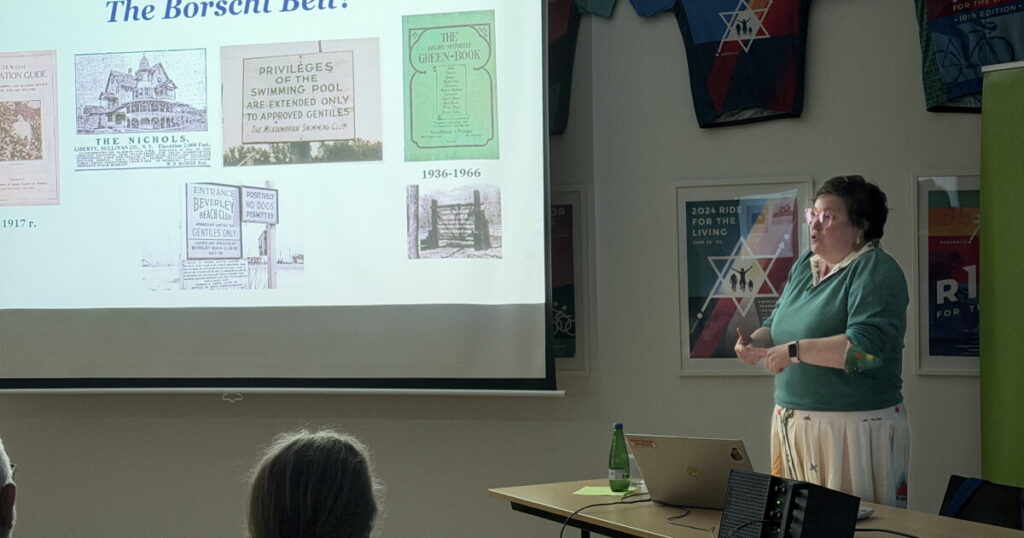
The JCC encourages individuals who have recently uncovered their Jewish ancestry or have historically distanced themselves from it to engage with their programs. Olga Adamowska, who leads the JCC’s educational initiatives, plays a pivotal role in this cultural renaissance by offering classes and engaging with local schools to impart Jewish history.
Malory Shaw
/
KUNR Public Radio
Adamowska’s upbringing was steeped in Christian traditions, yet she was always surrounded by narratives of Jewish history. Her childhood home was filled with books on the Holocaust, and at the age of five, she visited Auschwitz with her family.
“That was normal topic, you know. Concentration camps, you know, the killing Jews. Normal topic,” Adamowska recalled.
In 1994, a family trip to Krakow to explore Jewish culture fueled her curiosity. At the time, Krakow was perceived as a risky destination, further intrigue deepened her inquiry into her family’s past.
“I was like, ‘Okay, so what’s going on?’ Because it’s a bit creepy to talk all the time about Holocaust and … like going to the, you know, not funny place when you’re a kid,” she said.
By the age of 12, Adamowska confronted her mother about these peculiar trips and was informed that their family had Jewish roots. Her mother had never concealed this fact but had not highlighted it either. This revelation set Adamowska on a journey to understand her dual Polish and Jewish identities.
Her grandmother was a vital connection to their Jewish ancestry, but after her passing, reconstructing the family tree became challenging. Some stories, such as her grandmother’s brother’s death during World War II, were too painful to probe.
“I knew that it’s so difficult to ask the questions because I couldn’t imagine when I was a kid how is to lose your brother during a war,” Adamowska shared. “So I never want to push this story.”
Through photographs and distant relatives, Adamowska has pieced together fragments of her heritage, realizing the depth of what has been lost.
“It’s like very painful sometimes because I understand that I will never see my family tree in the same way, like other Jews,” she said. “I lost that, and I will never say that, ‘Okay, this is the tradition of my family.’”

Malory Shaw
/
KUNR Public Radio
Jolanta Gumula, deputy director of the Museum of the History of Polish Jews, notes that many people visit upon discovering their Jewish roots. “During the Second World War, it is … it was common story that a lot of Jews had false documents, yes, like Aryan documents with Christian names, especially children,” Gumula explained.
During the Nazi occupation, false identities were a means of survival. Jews adapted by learning Christian prayers, abandoning Yiddish, and altering their appearances. Polish women also played a crucial role, saving Jewish children by raising them as their own.
“A lot of those women started to treat those kids like their own kids, and they didn’t … they didn’t tell them that you know ‘You are a Jew.’ They raised them up as Catholic girls, as Catholic people,” Gumula recounted.
Today, the Jewish population in Poland is estimated at 17,000, a significant decline from the 3.5 million before 1939 (source). Adamowska believes the actual number might be higher, as many either do not claim or remain unaware of their Jewish heritage.
Despite the lingering shadows of the Holocaust, Adamowska emphasizes that Krakow’s Jewish community is vibrant and expanding. She often hears tourists discussing the Jewish history of Krakow without acknowledgment of the current community.
“I once heard when someone was saying that, before the world [war], was a huge community here, and right now the Jews are only in the cemetery. And then I feel like it’s not fine because I’m staying here and I’m living here,” she stated.
The JCC remains a vital resource for individuals embarking on their journey of identity discovery, offering a sense of belonging and understanding to those with stories akin to Adamowska’s.
This story is in partnership with Fuente Latina.
“`