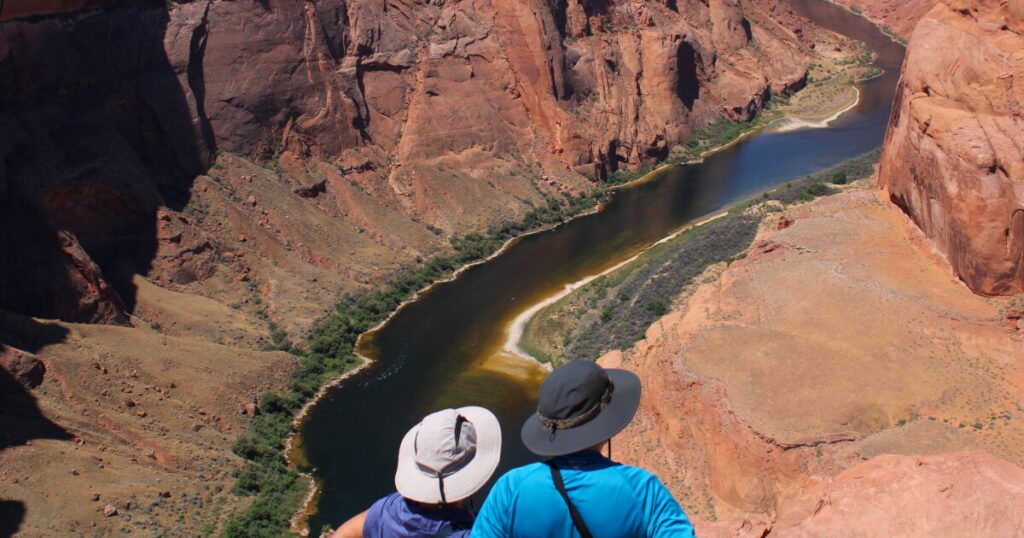
Water is the lifeblood of the American West, and right now, a legal and political battle over who gets how much of it is reshaping the future for tens of millions of people. Arizona has decided it will no longer sit quietly while the federal government decides how to divide a shrinking Colorado River.
The Arizona Department of Water Resources filed a motion to intervene in Nevada’s existing lawsuit against the federal government, and the Central Arizona Project — which runs a 336-mile canal system delivering Colorado River water to the Phoenix and Tucson areas — followed suit less than two weeks later. Together, these moves mark a significant escalation in a dispute that has been building for years over how to manage a river that supplies nearly 40 million people across seven Western states.
The core problem is straightforward: drought and climate change have reduced the Colorado River’s flow, but policymakers cannot agree on who should take less water. That stalemate has now moved from the negotiating table to the courtroom.
What the Lawsuit Actually Asks For
Nevada’s original lawsuit centers on one central demand — that the Interior Department scrap and redo its plans for cutting back water use across Arizona, California, and Nevada, the three states collectively known as the Lower Basin.
The backstory involves years of closed-door negotiations among all seven states that share the river. The Lower Basin states offered voluntary cutbacks. The Upper Basin states — Colorado, New Mexico, Utah, and Wyoming — did not, arguing they are already cutting back because reduced snowmelt means less water reaches them, even as they remain legally obligated to send a fixed amount downstream.
After states blew through major deadlines without reaching a deal, the federal government reluctantly came up with its own plan. That plan places all new mandatory cutbacks on the Lower Basin, with Arizona absorbing the hardest hit — potentially losing up to 40% of its Colorado River supply in any given year.
Arizona and Nevada were quick to call that plan unfair. Now they are going further, arguing it is also illegal. The lawsuit contends that federal law requires environmental review of the harm caused by major new water management decisions — and that the Interior Department failed to adequately assess the damage its plan would cause to millions of people and major industries.
Arizona’s top water official, Tom Buschatzke, said the federal plan would “devastate” the state’s economy and “ignores basic elements of the law of the river.”
Brenda Burman, general manager of the Central Arizona Project, was equally direct:
“It fails to adequately assess the devastation, the economic harm, the harm to everyday communities, the harm to the canal itself. There were many problems there.”
Cynthia Campbell, a longtime water lawyer and former water advisor for the City of Phoenix, summed up what the suing parties want:
“What they’re looking for is they want it redone. And I suppose Nevada believes that if that happens, there might be a different outcome.”
The Bigger Threat Lurking in the Background
Getting the federal plan redone is only part of what Arizona’s legal intervention is designed to accomplish. Woven into the filing is a broader warning aimed squarely at the Upper Basin states.
Arizona’s motion argues that the Lower Basin is bearing an unfair burden because Upper Basin states are violating the foundational 1922 Colorado River Compact — the agreement that has governed how the river is shared for more than a century. That argument sets the stage for Arizona to potentially drag an Upper Basin state directly before the U.S. Supreme Court.
Elizabeth Koebele, an associate professor at the University of Nevada, Reno who specializes in water policy, calls that potential Supreme Court showdown the “nuclear option.” The current lawsuit is not that — but it is Arizona’s way of putting its legal ammunition on the record.
“I kind of see it as almost like a low-hanging fruit option to get some of those quote-unquote complaints, concerns, evidence, different perspectives on the table,”
Koebele said.
“For that reason, it makes sense that Arizona jumped on board.”
Water policy experts overwhelmingly agree that a Supreme Court showdown would not be a good way to resolve Colorado River disputes, and state negotiators have consistently said they want to avoid one. But CAP officials say the Upper Basin states have already fallen below the legally mandated amount of water they must deliver downstream — meaning the grounds for such a case may already exist.
Buschatzke acknowledged that Arizona spent nearly four years trying to avoid legal action before concluding it had no choice.
“An outcome in which that burden falls on the Lower Basin and specifically on Arizona is an unacceptable outcome,”
he said.
“And while we tried for almost four years to find a collaborative path forward with the Upper Basin, that didn’t happen.”
By laying out its case within Nevada’s suit, Arizona is opening two possible paths. A judge could rule on some of these complaints before they ever reach the Supreme Court. Or, the pressure of strongly-worded legal action could push all seven states back to the negotiating table — where they could write up their own agreement, potentially rendering the federal cutback plan irrelevant and bypassing the Supreme Court entirely.
Still, Koebele is skeptical that a negotiated deal is close:
“I’m really pessimistic about that happening. Just based on how slow and how conflictual the process was over the last five years.”
Nevada’s lead negotiator, John Entsminger, said last week that the lawsuit
“made things a little more tense”
in multi-state talks. In an interview with 8 News Now in Las Vegas, he estimated states are
“maybe 70%”
of the way to a deal, adding:
“Major strides have been made. Significant agreements on how to operate the system have been agreed upon, but as with almost any negotiation at any human enterprise, it’s that last 10 percent that hold you up, right?”
Why the Nuclear Option Would Be Costly — In Every Way
James Eklund, a water lawyer who served as Colorado’s top negotiator from 2013 to 2019, laid out three reasons why taking this fight to the Supreme Court would likely cause more problems than it solves.
First, cost. Arizona lawmakers recently boosted the state’s Colorado River litigation fund to $9 million — a sum Eklund called insufficient for the kind of complex, drawn-out case that could land before the Supreme Court.
“It would shape up to be a very expensive proposition to wage war in this way,”
he said.
Second, time. Other major water disputes give a sense of how long this could drag on. A dispute over water between Texas, New Mexico, and Colorado over the Rio Grande took 13 years to settle. Kansas’s case against Colorado over the Arkansas River, filed in 1985, wasn’t resolved until 2009 — more than two decades later.
A Colorado River case would be even more complex, involving seven states, 30 federally recognized Native American tribes, and the country of Mexico. Eklund said the stakes are too high and the timeline too urgent to wait that long.
“We don’t have that time. We don’t have two years, we barely have two months. We need to be managing a river right now, and it’s just not acceptable. It’s just a failure, and there’s no other real way to put it, if we end up waiting decades for resolution of these issues.”
Third, even decades of litigation might not produce the comprehensive answers the river’s future requires. The Supreme Court can settle specific legal questions about water rights, but it cannot write a management plan for a river shared across an entire region.
“The Supreme Court will not answer everything to everyone’s satisfaction and put the whole question of the Colorado River management to bed,”
Eklund said.
“You’re not going to get what I think most people would want, what most Americans would want, which is just — tell us what the plan is.”
Despite those concerns, Eklund said he still believes there is time to find a better path.
“The question isn’t whether those states have legitimate legal disagreements. They do. The question is whether we have the political courage and creativity to resolve the practical problem before we spend the next decade or decades litigating it. I believe we do. I’m an optimist on this.”
What Happens Next
Even the existing lawsuit — far less sweeping than a full Supreme Court battle — is unlikely to move quickly. The federal government has requested an extension until December 10 to respond to Nevada’s initial complaint, meaning the next significant court development may still be months away.
Interior Secretary Doug Burgum pushed back on Arizona’s decision to join the lawsuit. In an interview with Tucson news station KOLD, he said
“litigation doesn’t create more water”
and added:
“If this thing ends up in court that would be a bad deal for Arizona. We believe that the Governor is wrong on this topic.”
Campbell, the Phoenix water law adviser, noted that the lawsuit asks for the Interior Department’s 10-year plan to be redone, but does not seek to immediately halt the rules while the case proceeds.
“It does ask for a stop, but it’s not like a stop in the next couple months. How long that takes to work through that — to get a court to address that issue of whether or not there are grounds for an injunction — that could take a little bit of time. How much time? Well, it’s hard to say.”
In the meantime, real uncertainty hangs over the cities, farms, and businesses that depend on Colorado River water in Arizona, California, and Nevada. While the federal rules outline cutback levels, a separate side deal between the states appears to have stalled, leaving open questions about exactly how much water each state can draw from the river as soon as 2027. The Lower Basin states have been working on an agreement to more evenly distribute cutbacks so Arizona does not bear the full impact — but the details of which cities and farms will reduce their use have slowed that process considerably.
About a month ago, Buschatzke told KJZZ that Arizona and Nevada have plans in place, and that California is “working out final details” on reducing water use among its largest users. For now, all sides wait — in court, at the negotiating table, and in the communities that depend on every drop.