Border crossings along the Arizona-Mexico line have dropped sharply in recent years — but people are still dying in the Sonoran Desert at a troubling rate. The gap between falling crossing numbers and stubbornly high death tolls is raising serious questions about where migrants are going, and why the desert keeps claiming lives even as fewer people attempt the journey.
According to data from the Pima County Office of the Medical Examiner and Humane Borders, July 2026 recorded 19 migrant deaths — the highest July toll in two years. As of late October 2026, 89 migrants’ bodies have been recovered this year, compared to 102 for all of 2025. Meanwhile, U.S. Customs and Border Protection data shows that migrant encounters in Arizona’s Tucson and Yuma border sectors dropped roughly 61% from fiscal year 2025 to fiscal year 2026, following an 88% drop from fiscal 2024 to fiscal 2025.
The numbers tell a stark story: even as fewer people try to cross, those who do are dying at a disproportionately high rate.
Pushed Into Deadlier Terrain
Aid workers and researchers say the explanation lies in where migrants are now crossing. As enforcement has concentrated around traditional crossing corridors, migrants have been pushed onto more remote and dangerous routes through the desert.
Joel Smith, operations manager for Humane Borders, a Tucson-based humanitarian organization, described the shift in plain terms.
“In 2006, it was easy. They just walked through the Altar Valley,”
he said.
“Now you rarely see anybody walking through the Altar Valley because the Border Patrol has flooded the Altar Valley.”
The Altar Valley is a long north-south corridor stretching northeast from Sasabe on the border to west of the Tucson Mountains. Smith said migrants are now crossing through mountain ranges like the Baboquivaris — terrain that is steeper, more isolated, and harder for Border Patrol agents to access on foot.
“They’re in the Baboquivaris, which is much more inaccessible, more steep, much more challenging,”
he said.
Mónica Ruiz House, media outreach and digital organizing coordinator for No More Deaths, another Tucson humanitarian group, pointed to research from the University of Texas at El Paso and the University of Arizona’s Binational Border Institute that documents the same pattern.
“The more surveillance, the more border tech, the more border militarization you have, the deadlier it becomes,”
Ruiz House said,
“because it becomes much harder to cross in easy crossing routes, because those become surveilled.”
In the West Desert area — which includes parts of the Sonoran and Mojave Deserts — reaching a highway can mean walking 60 miles in 115-degree heat.
U.S. Customs and Border Protection places the responsibility elsewhere. A Border Patrol spokesperson said in an email:
“Smuggling organizations are adaptive and routinely put profit above human life. They may exploit remote and dangerous terrain, provide illegal aliens with misleading information and abandon individuals during dangerous crossings.”
The agency said it has agents trained as emergency medical technicians as well as Search, Trauma and Rescue teams capable of operating in remote desert environments.
How Many Have Really Died?
The official death counts may significantly undercount the true toll. Since 1981, the Pima County Office of the Medical Examiner has recorded 4,517 sets of migrant remains found in the Arizona borderlands, of which 1,639 remain unidentified. But both humanitarian groups and Border Patrol acknowledge the official figures are only a fraction of actual deaths.
Miranda Haley, a representative of Humane Borders, said statisticians she consults regularly suggest the true number could be far higher.
“What I hear pretty consistently is that our death numbers seem to reflect probably about half to maybe a third of what is actually out there,”
she said.
“I’ve heard numbers as high as 10 times what is reported.”
Smith says the reality in the field supports that grim assessment. Scavengers like coyotes and vultures scatter remains quickly, he said. On a search,
“if you’re lucky, you find a bone.”
“I would say we don’t even find one in ten,”
he said.
“And that’s going to scare and anger people.”
There are also procedural gaps in how deaths are counted. Smith said Border Patrol tallies only the remains its own agents locate.
“If a sheriff’s deputy finds remains, it doesn’t get counted. If you or I find remains, it doesn’t get counted,”
he said,
“even though the medical examiner has the remains on a table at the morgue.”
A 2024 report by the U.S. Government Accountability Office confirmed that Border Patrol’s policies could exclude some migrant deaths when agents are not directly involved in locating or identifying remains. The 2025 Pima County Medical Examiner Annual Report documented 106 migrant remains recovered in fiscal year 2025, while the Border Patrol Tucson sector reported 70 deaths for the same period — a difference of 36 cases.
Water Stations Under Threat
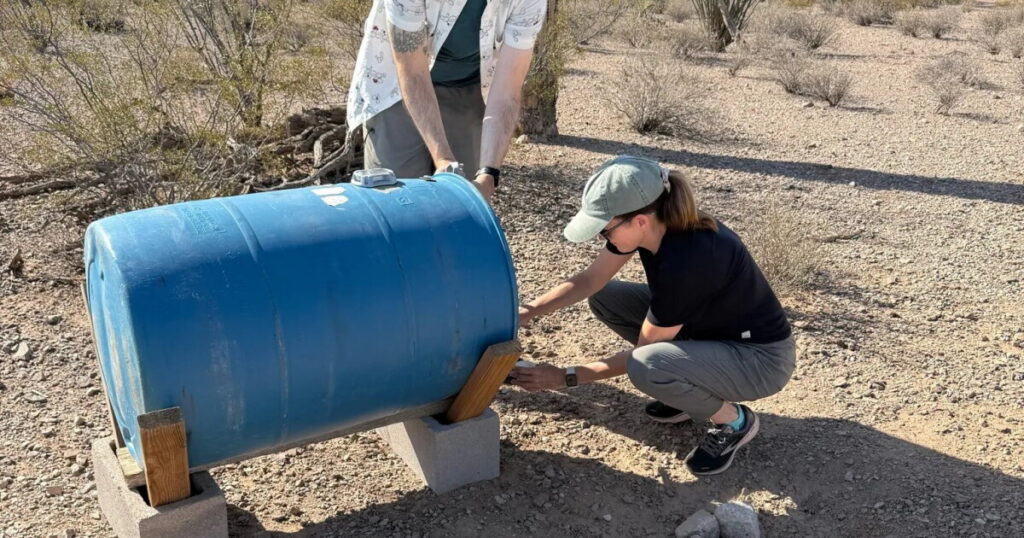
Humane Borders has for years placed water stations across the southern Arizona desert — large blue 55-gallon barrels mounted on stands with flags to make them visible. The stations are regularly vandalized, with barrels stabbed, shot, or attacked with power tools and accelerants. Repairs add up: a new barrel costs around $100, poles and flags roughly $50, locks about $85, and stands less than $5.
Smith said vandalism increases in winter months. Haley noted that
“vigilantes and alt-right provocateurs are very fair weather”
— they avoid the extreme heat and monsoon season, making summer the easier time for volunteers to operate.
Beyond vandalism, geography limits where water can be placed. Roads in the western desert can be more than 20 miles apart, and water can only be placed as far as a truck can drive, plus the reach of a hose. Large portions of Cabeza Prieta National Wildlife Refuge and Organ Pipe Cactus National Monument are federally designated wilderness areas where no new roads can be built — and where people are known to die.
On October 1, 2026, those constraints grew tighter. Humane Borders announced that federal agencies had declined to renew permits for 12 water stations across southern Arizona. The National Park Service denied permission for stations at Organ Pipe Cactus National Monument, and the U.S. Fish and Wildlife Service denied permits affecting Cabeza Prieta National Wildlife Refuge.
In a letter published by the Tucson Sentinel, Organ Pipe Cactus National Monument Superintendent Raquel Montez wrote:
“While we understand the stated intent is to assist migrants and provide lifesaving water, their presence on park service lands inadvertently encourages migrants to travel deeper into dangerous terrain under a false sense of security.”
Haley offered a direct response to the argument that water stations incentivize crossings. Nobody, she said, leaves their family and home to hike a deadly desert for her
“warm, slightly chlorinated tasting water.”
She said water stations are placed where the data already shows deaths are occurring.
“Those red dots on that map, they show up long before the blue water barrels do,”
she said.
“It’s already happening. The very least we can do is put out water.”
A Policy Debate With Life-or-Death Stakes
Haley said the data points to a clear historical pattern. A sharp jump in recorded deaths followed major enforcement operations launched in the 1990s.
“Operation Gatekeeper, Operation Hold the Line, they were all born out of the policy of prevention to deterrence,”
she said.
“We have over 20 years of evidence showing that prevention through deterrence does not work at keeping people out. What it does is drastically increase the number of deaths in the desert.”
Operation Gatekeeper was a Clinton-era initiative aimed at stopping unauthorized crossings along the San Diego border sector. Operation Hold the Line was a 1993 Border Patrol effort in El Paso that used physical lines of agents and vehicles to block crossings.
“The map that you’re looking at, all of those red dots, all of those deaths are engineered by policy,”
Haley said.
“They are not inevitable. It is an engineered death.”
Haley said that even among conservative ranchers along the border, she hears surprising agreement.
“When you are talking to conservative people on the border, Republican ranchers who are staunchly Republican, they will say the same thing to you that I would say, which is that we need a better immigration policy that allows people to come and work here (in the U.S.), maybe only for a little while, and then go home and then come back. But it shouldn’t be prevented through deterrence,”
she said.
Border Patrol declined to comment further on prevention through deterrence or the research linking it to desert deaths. The agency’s statement did acknowledge
“the extreme dangers posed by the Sonoran Desert, including heat exposure, dehydration, difficult terrain, and the exploitation of vulnerable people by transnational criminal organizations.”
Haley noted that illegal entry is legally a misdemeanor.
“It does not come with a death sentence, and it certainly doesn’t come with a death sentence before it’s been tried in court. But the prevention through deterrence policy has turned the desert into a weapon, and it is skipping the court system.”
She said the message she hears from migrants in the field is remarkably consistent across languages and accents:
“I would not be here if I had any other option. But I would rather die in this desert trying than watch my family starve in front of me.”
“There is not a more painful or lonely way to die than the way that you die in the desert,”
Haley said.