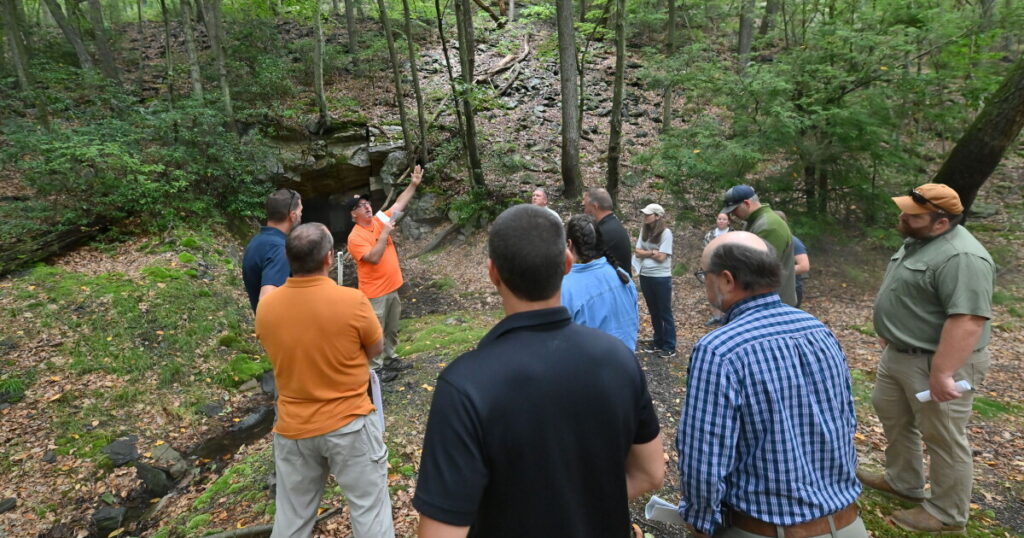
Hidden within the mountainous landscape of Shickshinny, Pennsylvania, lies a man-made cave, a relic of the region’s coal mining past. As visitors approach, they are greeted by a cool breeze from the hollowed mines and the sight of streams laced with pollutants trickling into Rocky Run on State Game Lands 260.
Mike Hewitt, program manager for the Eastern Pennsylvania Coalition for Abandoned Mine Reclamation (EPCAMR), explains the process: “Water falls on top of the mountain… you can see all the cracks and the rock and everything. It percolates down through, ends up hitting the coal mine underneath all the voids, and that’s where it comes in contact with the metals and the acidity. Then it comes out at the lowest point, which happens to be here.”
Addressing Abandoned Mines
The region’s complex environmental issues recently drew the attention of Nathan Houtz, Pennsylvania Department of Environmental Protection’s deputy secretary for acting and abandoned mine operations. Alongside EPCAMR and other local organizations, Houtz toured several locations in Luzerne County to observe ongoing reclamation projects. “It’s very important to restore these lands. You know, fill in these pits… some of them are safety hazards, you know, get the streams back on the surface so that we don’t have water going down into mines, creating acid mine drainage,” he emphasized.
Restoration Efforts
Initiatives to reclaim the area’s natural beauty have been funded by the Pennsylvania Department of Environmental Protection (DEP). The Luzerne Conservation District, in collaboration with Larson Design Group, is working to remove coal waste piles and a historic mining structure while also sampling the water from the cave. Keith George, deputy director of the conservation district, likens the mine spoils to “geological coffee grounds” that taint the water quality with metals.
Challenges and Solutions
Despite the crystalline appearance of the water flowing from the cave, it harbors a low pH and high levels of aluminum, posing a threat to local aquatic life such as the native brook trout. EPCAMR is collecting data to develop a treatment plan that may incorporate a limestone-based system to mitigate these issues. Bobby Hughes, EPCAMR’s executive director, notes the deceiving nature of the water, stating, “But it’s not. It’s deceiving. That’s got the low pH in it, so that’s what happens with aluminum.”
Wildlife and Habitat
Interestingly, the abandoned mines have become a sanctuary for federally endangered bats. The caves maintain a stable temperature ideal for hibernation, creating a new habitat born from the coal mining legacy. “Even though this is our legacy of coal mining, there’s now an endangered species that has created habitat from that legacy,” said Glace from Larson Design Group.
A Vision for the Future
Transforming the region from a “black wasteland” into thriving ecosystems is a long-term goal. State Game Lands 260, now a serene woodland, offers hope for diverse wildlife. Kevin Wenner, wildlife resource manager for the Northeast Region with the Pennsylvania Game Commission, sees the area as prime habitat for both game and non-game species, highlighting the importance of hemlocks and bat boxes in restoring ecological balance.
Through ongoing efforts and partnerships, Luzerne County is witnessing a gradual but promising environmental revival. As Houtz observed, “I’ve seen these areas 15, 20 years ago being permitted, you know, black wastelands. So to see the streams back on the surface to see revegetation, all that you know, wildflowers and pollinators that we saw. It’s great. It’s definitely an improvement.”