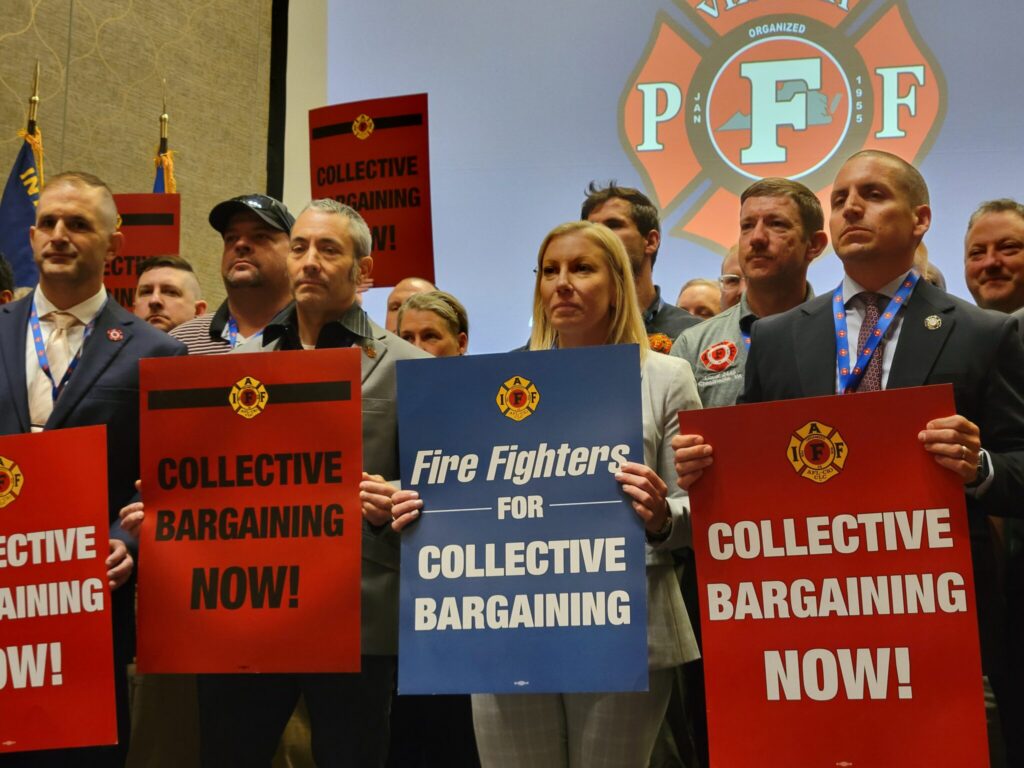

Members of Virginia Professional Firefighters association hold signs during their biannual convention in May to protest Democratic Gov. Abigail Spanberger’s veto of collective bargaining legislation. New research found a significant spike in labor union membership, but growth is highly dependent upon state politics. (Photo by Charlotte Rene Woods/Virginia Mercury)
Labor union membership is on the rise in the U.S., with growth heavily influenced by state politics.
The country added over 411,000 union members last year, the highest since 2008, according to a study by the Illinois Economic Policy Institute and Project for Middle Class Renewal at the University of Illinois.
Over 14.6 million U.S. workers, around 10% of the workforce, were union members by year-end. States supporting collective bargaining rights saw thrice the union membership growth compared to right-to-work states, which ban mandatory union membership or dues.
“The state of the state is the number one driver,” said study author Robert Bruno from the University of Illinois. “Anti-union policies suppress worker will, whereas supportive laws boost membership.”
The report shows collective bargaining states have a 14% union membership rate, compared to 5% in right-to-work states. Workers in collective bargaining states earn more, with adjusted average hourly earnings of $37.24 versus $34.16 in right-to-work states.
While union density is far from its 1954 peak, public support is rising. Recent years saw Southern states enact laws to limit union growth, while federal actions under President Donald Trump aimed to reduce collective bargaining rights for federal workers.
Growing public support for labor unions spans both Republicans and Democrats, as shown by Gallup polling. Coauthor Frank Manzo IV noted more public sector workers turned to unions amid federal challenges.
However, conservatives argue that unions’ impact on wage growth is overstated. A review by the Mercatus Center found powerful unions may slow job growth and increase company closures.
State lawmakers passed numerous bills to enhance worker protections, including expanding collective bargaining in 19 states, tracked by State Futures. Illinois, Washington, and Virginia attempted to expand bargaining rights, but Virginia’s measure was vetoed by Gov. Abigail Spanberger.
Spanberger supported expanding collective bargaining but suggested amendments, including delaying implementation until 2030. These were rejected by the General Assembly.
This story was originally produced by Stateline, part of States Newsroom, supported by grants and donors as a 501c(3) public charity.