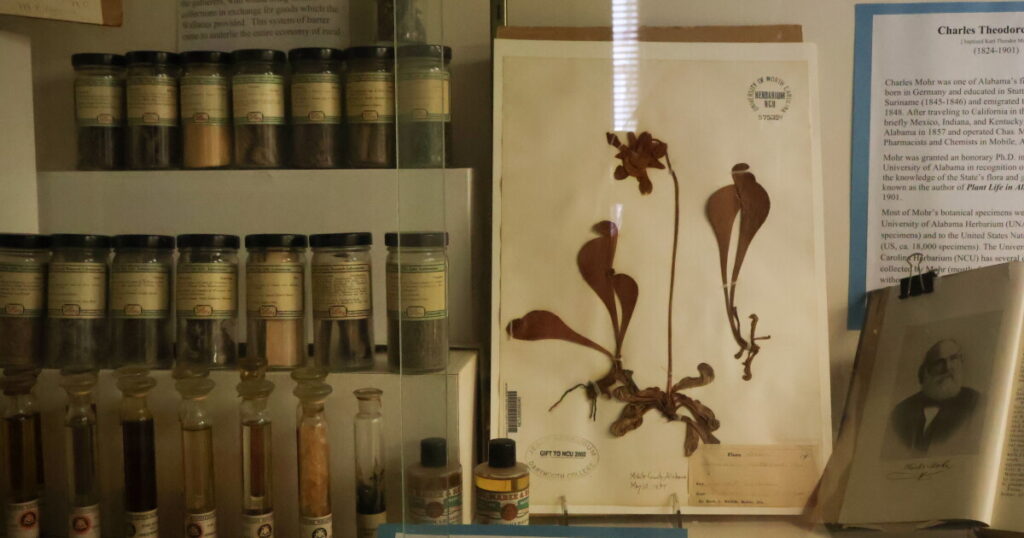
Walk into the UNC-Chapel Hill Herbarium, and you’ll find yourself in a place teeming with the essence of history and science. Although there aren’t any spells being cast, the shelves brimming with dried plants and oils might suggest otherwise. Every corner is adorned with a fascinating array of green hues, from olive filing cabinets to a mint-colored staircase, making it a haven for plant enthusiasts.
Sitting amidst this botanical treasure trove is Curator Carol Ann McCormick, who, in her green sweater, oversees the cataloging of over 800,000 specimens from around the globe. Her role involves meticulously labeling and preserving each sample to ensure the herbarium remains an invaluable resource for research.
In a recent development, McCormick was met with a mix of excitement and apprehension. The herbarium’s collection is set to double as UNC and Duke University have announced a merger of their herbaria under the North Carolina Botanical Garden. This consolidation will create the third-largest university herbarium in the United States, making it the largest in the Southeast.
The merger follows Duke’s controversial decision two years ago to close its herbarium, citing outdated facilities. Rather than dispersing the collection, Duke’s specimens will now be relocated to Chapel Hill.
“It speaks volumes that UNC found the vision and resources to rescue an irreplaceable biodiversity collection that Duke spent a century building and then chose not to keep,” commented Kathleen Pryer, former director of Duke’s Herbarium, expressing her disappointment over Duke’s decision.
McCormick, with her 26 years of experience at UNC, acknowledges the challenges ahead. While the scientific community hoped to see Duke’s collection remain operational on its original campus, the focus now shifts to ensuring the successful integration of the collections at UNC.
“If it was me, I’d be pissed as hell, right? Worried, relieved — it’s a whole range of emotions. And I’m feeling all those things now, but from the other side,” she shared.
The Challenge of Moving Duke’s Botanical Collection
UNC has a history of absorbing other universities’ herbaria, but Duke’s collection is notably larger. The herbarium currently occupies the fourth floor of Coker Hall, which is already brimming with specimens.
Duke’s collection, comprising over 825,000 specimens, including lichen, fungi, and vascular plants, will be housed at the former Frank Porter Graham Child Development Center in Chapel Hill by 2027. To accommodate both collections, totaling about 1.7 million specimens, UNC plans to construct a new Plant Biodiversity Research Center.
1 of 7
— unc-duke-herbaria-merger8.JPG
Inside the UNC Herbarium on Tuesday, Sept. 1.
Daneen Khan / WUNC News
2 of 7
— unc-duke-herbaria-merger2.JPG
Specimens collected in 1937 sit in the UNC Herbarium on Tuesday, Sept. 1.
Daneen Khan / WUNC News
3 of 7
— unc-duke-herbaria-merger5.JPG
Specimen from North Carolina stored in folders at the UNC Herbarium on Tuesday, Sept. 1.
Daneen Khan / WUNC News
4 of 7
— unc-duke-herbaria-merger6.JPG
A soil map and sticker decorate the front of a cabinet in the UNC Herbarium on Tuesday, Sept. 1.
Daneen Khan / WUNC News
5 of 7
— unc-duke-herbaria-merger3.JPG
A workspace inside the UNC Herbarium on Tuesday, Sept. 1.
Daneen Khan / WUNC News
6 of 7
— unc-duke-herbaria-merger4.JPG
A research poster hangs against a chalkboard inside the UNC Herbarium on Tuesday, Sept. 1.
Daneen Khan / WUNC News
7 of 7
— unc-duke-herbaria-merger7.JPG
Rows of floor-to-ceiling cabinets store specimens at the UNC Herbarium on Tuesday, Sept. 1.
Daneen Khan / WUNC News
Director of the NC Botanical Garden, Damon Waitt, stated that the research center is in the fundraising phase, with a goal of raising $100 million. He is optimistic about securing the funds within two years.
“These collections take up a huge amount of space, and there aren’t just lots of empty buildings floating around on either campus that can accommodate a collection of that size,” Waitt explained.
A Magnet for Plant Scientists
Waitt outlined the multifaceted use of the herbarium for research, from conservationists logging rare plant specimens to state agencies performing vegetation surveys. University researchers also engage in diverse projects utilizing the physical specimens and their DNA sequences.
According to Waitt, Duke’s strength lies in its collection of mosses and lichens, while UNC excels in vascular plants. The merger will establish a prominent hub for plant biodiversity research in the southeastern United States.
“I think it’s going to act like a magnet for researchers from both local universities and universities beyond North Carolina to study the flora of the southeastern United States, because it will be the best collection of plant biodiversity in the entire southeastern United States,” Waitt said.
While Pryer wishes UNC success in managing the merged herbaria, she cautions that strategic planning and adequate staffing will be crucial to maintaining the collection’s research value.
“Now UNC needs to finish the job and hire the curators and faculty to match, or this becomes the third-largest pile of specimens in the country, not the third-largest university research herbarium,” she remarked.