Surprising Allies: How Lawn Grass Supports Bee Populations
In a groundbreaking study from the University of Georgia, researchers have uncovered an unexpected ally in the battle to support bee populations: lawn grass. This discovery highlights the potential of centipedegrass, a commonly found turfgrass in the Southeast, to serve as a vital food source for bees.
The research, published in the Journal of Insect Conservation, was conducted by Shimat Joseph, Oluwatomi Ibiyemi, Karen Harris-Shultz, David Jespersen, Michael Ulyshen, and Brian Schwartz. They explored how urban expansion and pesticide usage have reduced traditional floral resources for bees, leading these insects to adapt by turning to centipedegrass.
“Urbanization is reducing both nesting habitat and food resources for them, so anything we can provide in addition helps,” said Joseph, an associate professor in the UGA College of Agricultural and Environmental Sciences, in an interview with UGA Today.
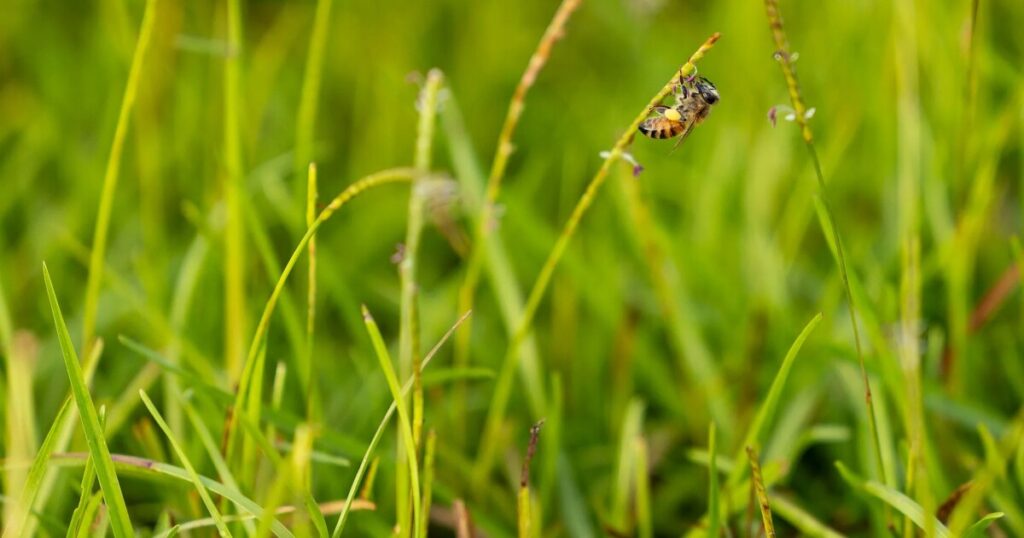
The study involved observing over 150 bees from 28 different species, including bumblebees, honeybees, and sweat bees, across various yards in Georgia. Researchers noted that bees collected pollen from the grass to feed themselves and their offspring, demonstrating a new dynamic in urban pollination practices.
An intriguing finding from the study indicated that less frequent lawn mowing could enhance bee conservation. Allowing lawns to go uncut for just 10 to 12 days can enable centipedegrass to flower, providing an accessible food source for bees during critical times.
“If you skip just one mowing, you create an opportunity for the grass to flower, and bees can use that resource,” Joseph emphasized. “The goal isn’t to stop mowing. It’s to manage lawns in a way that gives bees an extra food source.”
One of the key advantages of centipedegrass is its longevity compared to traditional flowers, offering bees a source of nourishment well into late September. Joseph noted, “By July and August, many trees have stopped flowering. That’s when these grass flowers may become another opportunity for bees. They may not be showy, but we know that bees are definitely using them.”