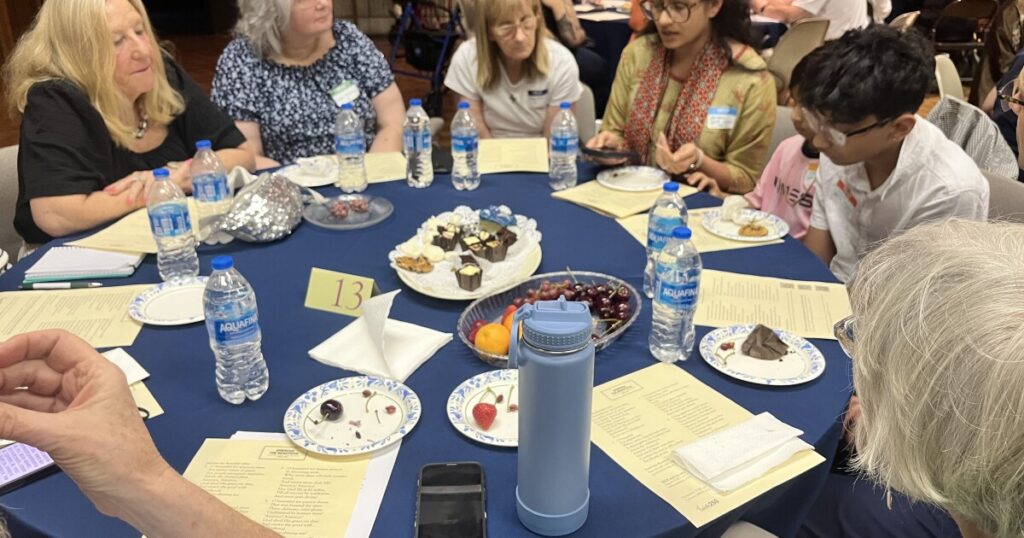
In a unique gathering at Temple Hesed in Scranton, diverse faith communities came together to explore the essence of America through sacred texts. This was the inaugural meeting of Faith250, aimed at understanding American values as the nation approaches its 250th anniversary.
Approximately 100 participants from varied religious backgrounds, including Jews, Mormons, Buddhists, Muslims, and Christians, sat in round tables discussing the poem “America the Beautiful,” penned by Katharine Lee Bates in the late 19th century.
“Everybody here knows something that I don’t, and that’s why we’re here together,” said Rabbi Daniel Swartz, emphasizing the event’s collaborative spirit.
Exploring Sacred Texts Together
Faith250, initiated by Rabbi Swartz, involves multiple sessions where participants delve into historical texts. The Scranton group is noted for its diverse participation, with Rabbi Swartz proudly highlighting, “We do, Scranton,” when asking which group had the most varied congregations in the country.
Interactive Discussions
The event encouraged participants to share personal stories and insights. Melinda Krokus, an Islamic scholar, prompted, “Just go around and name something that’s beautiful in your life, our area, our country, and/or our world.” The discussion revealed varied perspectives, with participants like Charlotte Ledbetter reflecting on past experiences in the South.
IF YOU GO
The group will meet three more times ahead of the Scranton Area Ministerium’s annual multifaith Thanksgiving celebration.
● The next meeting is Tuesday, Aug. 11, from 7 to 8:30 p.m., at the BAPS Shri Swaminarayan Mandir Hindu House of Worship, 311 Oak St., Scranton. The group will explore sections of the Declaration of Independence.
● The third meeting is Tuesday Sept. 15 from 7 to 8:30 p.m. at the Islamic Center of Scranton, 1509 West Pass Ave., Scranton. The group will explore “The New Colossus,” the poem on the base of the Statue of Liberty.
● The final meeting will be scheduled for October.
● For more details on the next event, visit https://www.zeffy.com/en-US/ticketing/faith250-declaration-of-independence
Ledbetter shared, “My grandmother … we were strangers to everybody. Nobody wanted to be friendly down there,” highlighting her contrasting positive experiences in Scranton.
Hopeful Perspectives
As discussions unfolded, participants dissected the poem line by line. Rabbi Marjorie Berman posed the question, “What do people think that that might mean? ‘Patriot dream that sees beyond the years,’ what would your guess be that she’s saying there?”
Participants were encouraged to express what the poem meant to them and the hope it inspired. Shivani Patel drew parallels between the poem and a Sanskrit peace prayer, reciting it in its native language before offering a translation.

Reflecting on Challenges
As the session neared its end, Rabbi Swartz gauged participants’ feelings of hopefulness, noting that most raised their hands. Susan Blum Connors pointed out the importance of acknowledging the country’s issues to move towards a more beautiful future.
“The promise of that song is that we’re supposed to be beautiful, but we can’t make it beautiful until we recognize that there are fractures in our country,” Connors said, emphasizing the ongoing struggles with anti-Semitism, racism, and access to basic needs.