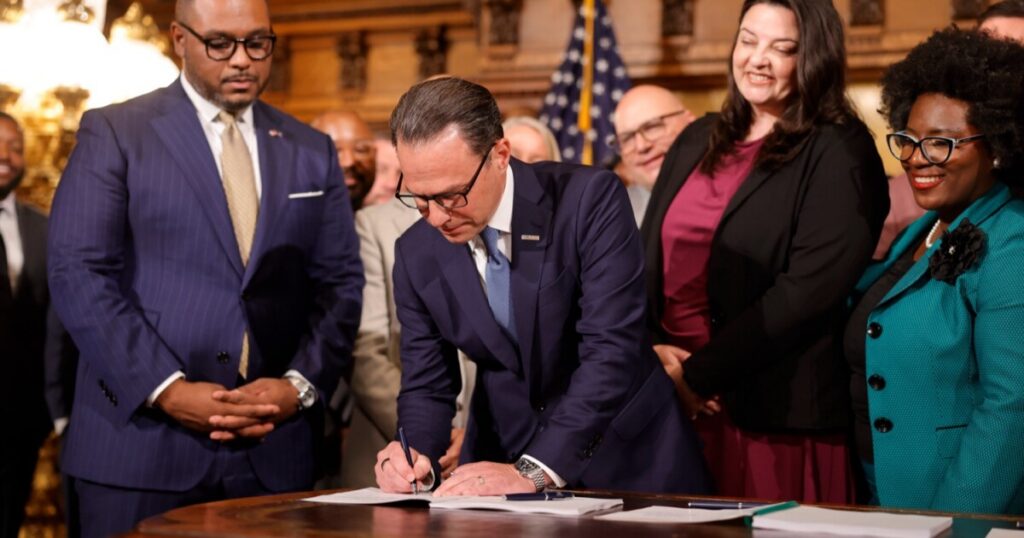
In what is being hailed as a bipartisan achievement, Governor Josh Shapiro has signed Pennsylvania’s new budget, highlighting it as a testament to cross-party collaboration. Despite its delayed approval, the budget was met with a sense of accomplishment from both sides.
“There is a lot in this budget that we can all be proud of,” remarked Shapiro, emphasizing the importance of the $50.8 billion plan that was passed just 12 days behind schedule — a marked improvement from the lengthy five-month standoff last year.
While the budget is smaller than Shapiro’s initial proposal, it is celebrated for its increased education funding and the absence of new taxes. However, some of the governor’s initiatives were left on the table.
The Unmet Goals
Among the unaccomplished goals were the increases in minimum wage and the legalization of recreational marijuana, both long-standing Democratic priorities. Efforts to regulate skill games also remained unresolved, despite Shapiro’s proposals in his February address.
Shapiro’s push for increased mass transit funding was another area that did not make the final cut. Nonetheless, he remains hopeful for future negotiations, particularly on skill games, in light of a recent state Supreme Court decision.
Key Achievements
The budget, passed with significant support — 167-35 in the House and 44-6 in the Senate — includes numerous notable allocations:
- $565 million to comply with a Commonwealth Court order to support underfunded school districts, plus additional funding for basic and special education.
- Mandatory 30-minute daily recess for students.
- Increased funding for Penn State and state-related universities, totaling $11.6 million.
- Enhanced grants for college students, career and technical education, and childcare worker support.
- Investments in mental health services, including $10 million for the 988 suicide hotline.
- Funding for environmental and infrastructure projects, such as hazardous waste cleanup and abandoned well plugging.
- A cost-of-living adjustment for retired public service workers.
Preserving the Rainy Day Fund
The decision to keep the $7.7 billion Rainy Day Fund untouched was a point of pride for the Republican-controlled Senate. Shapiro’s earlier plan to use a significant portion of the fund to balance the budget was met with caution due to potential future deficits.
Senator Rosemary Brown praised the fiscal prudence, highlighting a plan to allocate $775 million for local road and bridge improvements as a wise investment without tapping into the reserve.
School Funding and Beyond
Representative Kyle Mullins celebrated the additional $565 million for schools, a response to a 2023 court ruling. The budget also includes a provision for neuromuscular disease research and mandates for data center energy reporting.
Opposition Voices
Despite broad support, some Republicans, including Rep. Jamie Walsh, opposed the budget due to concerns over deferred payments to managed care organizations, which could exacerbate next year’s deficit.
Walsh expressed concerns over the budget’s growth, criticizing it as unsustainable. Nonetheless, Brown downplayed the issue, suggesting further analysis of Pennsylvania’s revenue landscape in the coming months.