Preserving Nebraska’s Unique Ecosystem: The Salt Creek Tiger Beetle’s Struggle for Survival
As the Salt Creek meanders through Nebraska, it silently bears witness to a delicate ecological balance, one in which the endangered Salt Creek tiger beetle plays a crucial role. The latest count of these beetles reveals both a glimmer of hope and a stark reminder of their vulnerability.
“Right there,” Malek points out.
“Oh yeah – There he goes,” Dunn replies.
The yearly census of the Salt Creek tiger beetle has shown a fluctuating population since the species was declared endangered two decades ago. A mere five years ago, 276 beetles were recorded, while a dry spring in 2023 reduced that number to just 92. Last year, 179 beetles were counted, and this year, the tally stands at 169. Despite these variations, Dunn remains cautiously optimistic, though he warns that a few adverse years could spell disaster for the species.
Why does this tiny beetle matter, and how does one respond to skeptics who dismiss them as insignificant bugs?
Dunn chuckled, addressing this common query: “That’s a very common thing that we get, and I tell them not to focus on the beetle,” he said.
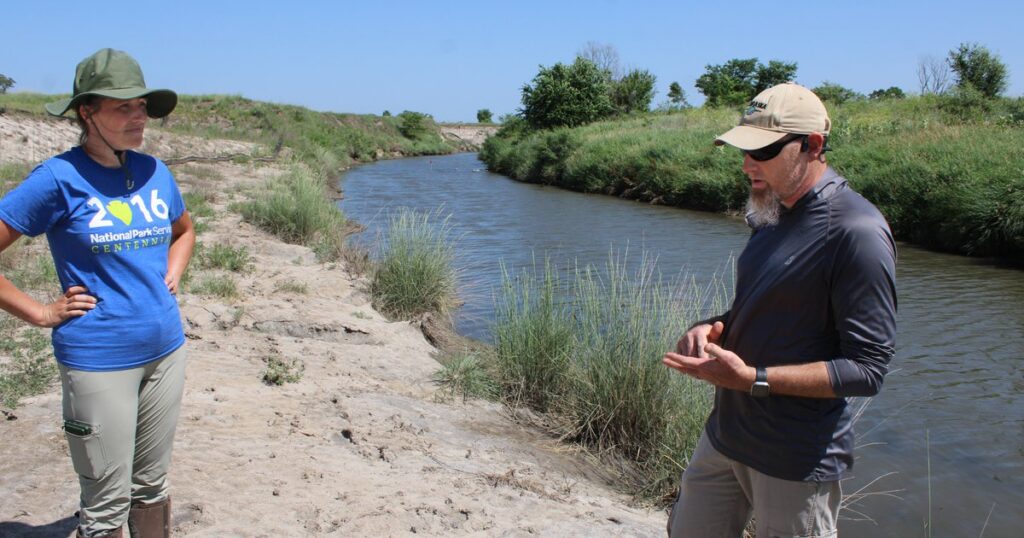
He gestured towards a creek bank, where the exposed salty soil mimics the mud flats that once dominated the landscape before urban development in Lincoln. “The beetle is just one tiny part of this really cool, unique habitat that we have here in Nebraska,” Dunn elaborated. “These areas are used by more than 600 species of insects, hundreds of species of birds, raccoons, foxes… I see turtles basking along these mud flats here. We’ve seen an increase in other insect types too, so creating this type of habitat also creates habitat for other species as well.”
Dunn pointed out the historical alterations humans have made to this environment, which are intricately linked to the beetle’s presence. Lincoln’s founding was tied to the region’s salt, and early engineering efforts aimed to mitigate flooding by altering the natural watercourses, as Dunn explained: “Lincoln was founded here because of the salt in the area, and… one of the problems was all of these creeks came together essentially very close to downtown… the idea was, well, we want to get the water out of the city as fast as possible, because Lincoln had a lot of floods in its early years, and so, because of that, the Army Corps of Engineers came in.” He continued, “They deepened, widened, and straightened a lot of the creeks that run through (the) city of Lincoln.”
This reshaping of the land led to the loss of mud flats, and additional motivations emerged for draining wetlands. Concerns about standing water and its association with mosquitoes and disease, as well as the unsuitability of wetlands for farming or construction, contributed to this trend. “So a lot of those areas are drained, they’re artificially filled in, and then you lose some of that original habitat, and that’s not to say that it’s necessarily a bad thing, it just happens to not be good for the tiger beetle,” Dunn noted.
With much of the critical habitat now privately owned, Dunn emphasizes cooperation with landowners. “They’re like, ‘Well, I’ve got this salt flat here, I’m worried that the tiger beetle is going to get on there, and you guys are going to make me always keep that as a saline flat.’ And we can’t do that, that’s their private property, we have nothing to do with that. But what I like to point out is that, ‘Hey, keep doing what you’re doing, because you have the beetles there, I want you to continue doing that.’ I really try to strike a balance with them, and hopefully they understand better that we’re all on the same team,” he says.
The ongoing efforts to safeguard the Salt Creek tiger beetle and its habitat will be evaluated again in the upcoming year, providing another opportunity to assess the effectiveness of conservation strategies.