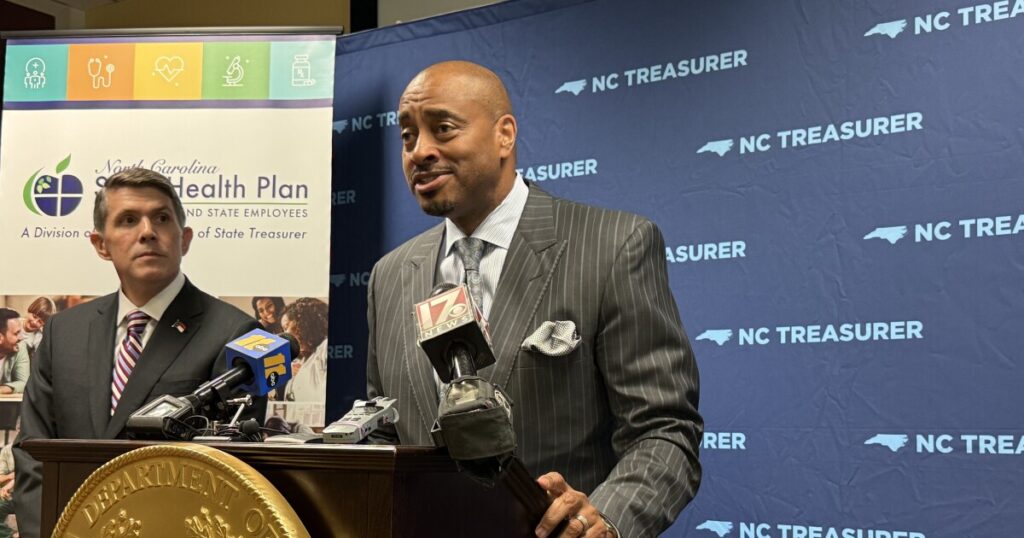
In a significant shift for North Carolina’s State Health Plan, Blue Cross Blue Shield is set to reclaim its role as the third party administrator, replacing Aetna in 2028. The decision followed a unanimous vote by the Health Plan’s Board of Trustees.
“Blue Cross brings deep experience, proven capabilities and a shared commitment to delivering better value and a better experience for the people who depend on the plan,” State Treasurer Brad Briner remarked post-vote.
Beyond its administrative responsibilities, Blue Cross NC will also assume the position of pharmacy benefit manager, with duties commencing on January 1, 2028. This contract spans an initial three-year term, with potential one-year extensions for 2031 and 2032.
Blue Cross NC’s vice president, Roy Watson Jr., expressed commitment to ensuring a smooth transition and collaborating with the plan to lower costs and enhance health for North Carolinians. “In the months ahead, our focus will be on ensuring a seamless experience for members and partnering with the plan and their leadership to deliver practical solutions that reduce costs and support a better health for the State Health Plan and all North Carolinians,” he stated.
The health plan’s administrative role is a familiar territory for Blue Cross NC, which held the position for over four decades before being replaced by Aetna in 2025. This change was initiated by then-Treasurer Dale Folwell. However, recent developments saw the State Health Plan opting not to extend Aetna’s contract or that of CVS Caremark, the pharmacy benefit manager.
The state’s request for proposals witnessed three submissions, including one from Aetna. Only two contenders met the minimum requirements, leading to Blue Cross NC’s selection. Briner highlighted the clarity of the decision, noting significant advantages in cost, member service, and other dynamics. “We ran a fulsome RFP process here. We got the results of that and the decision was very, very clear. Both from a cost perspective, from a member service perspective, as well, and then from every dynamic we can think of, there was really not much of a contest,” he said.
Tom Friedman, Executive Administrator of the State Health Plan, mentioned that the contract’s cost is not immediately defined, as decisions regarding population health management and member steerage programs are pending. This assessment is expected to take two months, with a focus on maximizing member benefits. “We are in the ROI business, not getting the lowest admin fee business,” Friedman commented.
Concerns about Blue Cross NC’s transparency, raised by Folwell, were addressed by Briner, who emphasized the plan’s proactive role in direct healthcare provider contracts. “Our ability to understand exactly what is going on increases dramatically as a result of that, and so those two things are linked in that way in that we have a front-row seat now rather than a back-row seat to all these conversations,” Briner explained.
Aligned with the preferred provider program announced earlier, the State Health Plan anticipates savings of approximately $1 billion between 2028 and 2030.
Aetna’s Response
Despite the contract change, Aetna pledged to support the State Health Plan and its members until December 31, 2027. In a statement, spokesman Phil Blando emphasized Aetna’s strengths: “We continue to believe Aetna is the strongest partner for the State Health Plan. Our expertise and service have helped the State Health Plan to advance its cost containment goals, successfully implement the Plan’s complex provider tiering strategy, and provide members access to high-quality care.”
Blando added that Aetna would review the decision in forthcoming weeks, hinting at a possible legal challenge. This mirrors Blue Cross NC’s unsuccessful legal action in administrative court when Aetna secured the contract in 2022.
State Health Plan leaders maintain confidence in their decision, with Briner expressing hope that the clear-cut nature of the RFP results will deter potential legal challenges. “There was really no contest in these RFPs. The decision was so very clear that I would hope that it would make people think twice about bringing action,” he concluded.