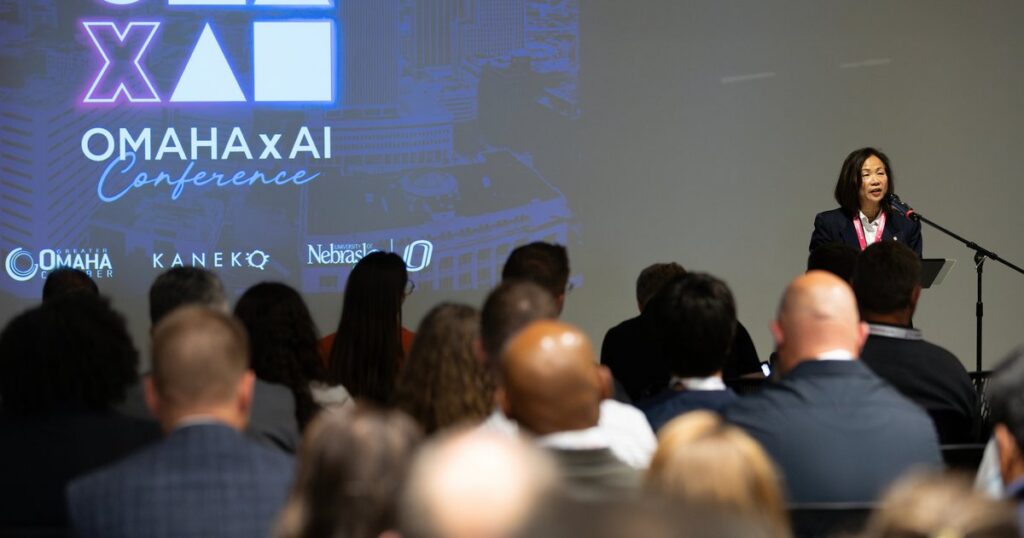
AI Integration at UNO: A Strategic Shift in Higher Education
With the rapid advancement of artificial intelligence, educational institutions are compelled to adapt swiftly. At the University of Nebraska Omaha (UNO), leaders have been proactive in embracing this technological wave. Chancellor Li highlights that the dialogue around AI and its role in higher education began in 2023, leading to the development of a dedicated AI degree program that launched in the spring of 2025.
“I think that was not enough,” Li remarked, emphasizing the need for a broader integration of AI. She recalls challenging her colleagues in 2023 with the notion of making UNO “AI-enhanced.” “What does it mean? In order to convince our learner why AI is part of our life, we got to do it by practice,” Li explained.
To support this initiative, UNO established the AI Learning Lab, a facility aimed at equipping faculty and staff with the necessary AI skills. Over 2,000 university members have already been trained, with a goal for all faculty and staff to complete AI training by year-end.
For the student body, professors at UNO are weaving AI into their teaching materials, and the university offers microcredentials in AI. These short courses are tailored for those seeking to acquire new skills in a rapidly changing job market.
“Most employers say, ‘Well, these days we won’t even hire any students or any graduate that never really touch AI or learn how to use AI,'” Li noted. She stressed that UNO is committed to offering an AI-enhanced curriculum, ensuring that students gain hands-on experience with various AI tools.
Despite the enthusiasm, there are concerns about students using AI for academic dishonesty. A 2025 Pew Research survey found that 59% of teenagers believe AI-assisted cheating is common in schools. To address this, UNO has implemented guidelines to promote ethical AI usage among students.
“We have an attitude of understanding we can use AI responsibly. We can use AI ethically,” Li stated. “We can use AI with a very active human mind, but not passively taking whatever information they spill out, we take it for granted.”
Nonetheless, Li identifies the rapid pace of AI evolution as a significant challenge. “That means we have to really run, not just walk, to catch up, to understand and constantly upskill ourselves, the knowledge about AI, the different types of AI tools out there, and the computing power we must equip,” she concluded.