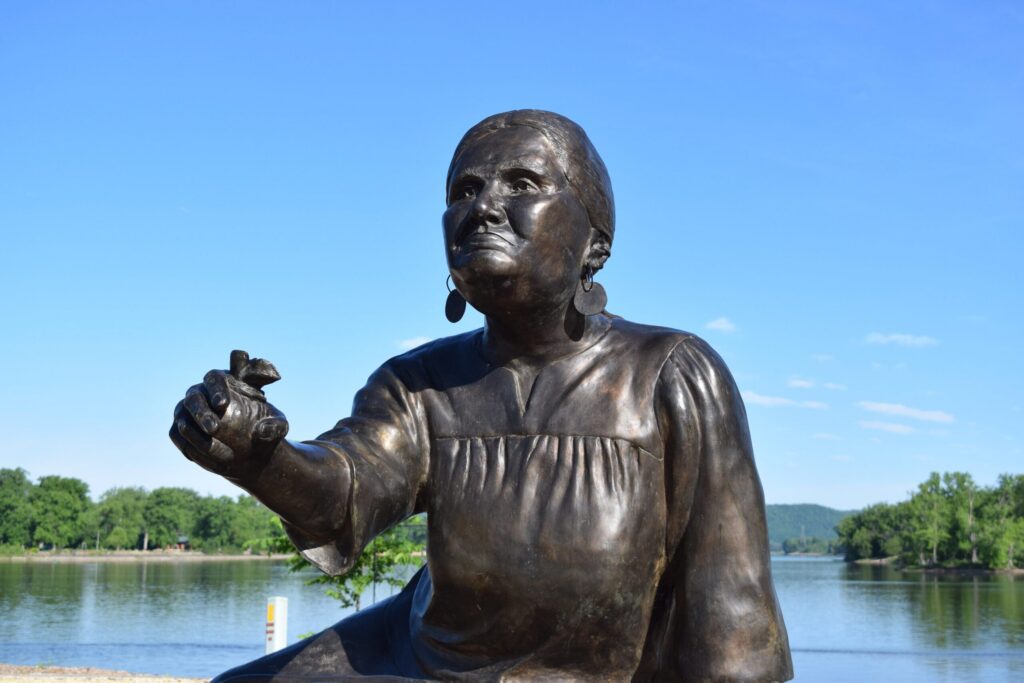
Downtown La Crosse welcomes a remarkable addition that pays tribute to a Ho-Chunk healer, Betsy Thunder, with a bronze sculpture installed in May. This comes after a previous statue was removed in 2020 due to its controversial depiction of Native Americans.
Situated in the newly expanded section of the Riverside International Friendship Gardens at Riverside Park, the sculpture honors Thunder, a revered healer from the late 1800s. Damian Thundercloud, District 2 Legislator of the Ho-Chunk Nation, highlights Thunder’s legacy in treating both Native and white residents of the area.
“Her willingness to treat just anybody, and her looking out for the well-being of just human beings, is partially the reason why she was chosen to be a representative of the nation in that garden,” Thundercloud stated.
The newly dedicated Ho-Chunk Garden, which will officially open on July 30, features indigenous plants historically used by Thunder for medicinal purposes. Created by Oneida artist Debra Fabian, the bronze artwork is strategically placed near the convergence of the Mississippi, Black, and La Crosse rivers, a site of historical significance for the Ho-Chunk people, often referred to as “highways of the past.”
The location also marks the former site of a 25-foot statue from the 1960s, which faced criticism for its stereotypical portrayal of Native Americans. The “Hiawatha” sculpture was removed in August 2020 following the recommendation of then-Mayor Tim Kabat who described it as “an issue of controversy.”

Although the previous sculpture was intended to honor an Iroquois leader from New York, it inaccurately depicted a Native figure in Plains-style attire, sparking criticism for not representing local Indigenous communities or acknowledging contemporary Native residents.
“Having Betsy there as an accurate representation of who we are as a people is extremely important,” Thundercloud expressed, emphasizing the significance for both the La Crosse community and local Ho-Chunk residents.
Many of Thunder’s descendants reside in the La Crosse area, and Thundercloud is eager to assist tribal elders in visiting the sculpture, which many recall from childhood stories.
Chuck Hanson, president of the Riverside International Friendship Gardens organization, noted that while his group wasn’t involved in the removal decision, it enabled the commemoration of the Ho-Chunk Nation.

The sculpture, based on actual photographs and meticulous historical research, features authentic details, including the style of moccasins and blanket Thunder would have worn.
Hanson remarked, “Each section of the gardens is meant to reflect the culture it’s named after,” with Thunder chosen to symbolize “friendship and community and healing.” He emphasized the broader cultural healing, acknowledging the painful history of Native displacement in America.