Nebraska City Schools Boost Literacy Efforts with Federal Grant Support
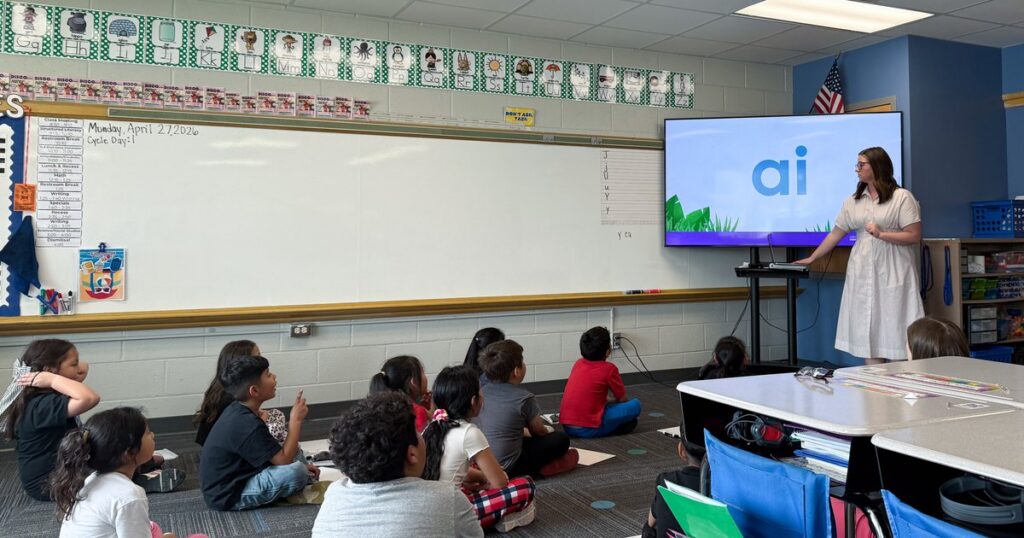
At Nebraska City Public Schools, students are engaging in hands-on literacy activities, combining auditory practice with tactile learning. Each student works with a personal booklet filled with velcro letters and syllables, which they use to form words they’ve practiced vocalizing. This multisensory approach not only reinforces learning but also emphasizes the importance of updated educational materials.
Funding for these resources often poses a challenge. Mark Fritch, superintendent at Nebraska City Public Schools, expressed the difficulty districts face in prioritizing such educational materials amidst financial constraints. “When a district is in financial trouble or struggling to cut costs, unfortunately, one of the first things to go are things like that, because we can’t cut the electrical bill, we can’t cut the busing,” Fritch explained.
Fortunately, Nebraska City was among the beneficiaries of a $55 million federal grant, known as the Comprehensive Literacy State Development grant. This funding enabled the district to enhance classroom materials and implement a system to monitor student progress in literacy skills.
Collaboration is at the heart of Nebraska City’s literacy strategy. Kate Sherwin, the district’s director of curriculum, instruction, and assessment, highlighted the collective effort involved in reading instruction. “It’s nothing groundbreaking,” Sherwin noted, emphasizing the importance of teamwork. “They need support from their team, from non-teachers also during reading time, from our paraprofessionals.”
Weekly meetings provide teachers the opportunity to discuss effective strategies and areas needing improvement. Hayward Elementary’s principal, Tammy Schaefer, expressed a desire to expand these efforts to involve families more deeply in the upcoming school year. “I’m hopeful this next school year that we can push it out even more to educate our families on what we need to do more for the partnership between parents and the school as well,” Schaefer stated.
The district held a literacy night, featuring high school students and community members reading books aloud, including stories in Spanish and Finnish. Schaefer described it as an “off the cuff” event but plans to organize similar events in the future.
Additionally, through the federal grant, over 15,000 books and 2,000 literacy kits were distributed to families, according to Cook from the Nebraska Department of Education. The Nebraska Growing Readers partnership has also distributed more than 800,000 books, enhancing family involvement in literacy.
Survey data revealed an increase in family confidence when provided with resources, Cook noted. “We’ve seen through our survey data that our families, where our grantees have provided those resources, have noted an increased level of confidence.”
Improvements in literacy are evident. Nebraska City’s second graders read 32 more words correctly per minute, surpassing the initial goal of 14. Meanwhile, third graders achieved 23 additional words, against a target of 12. Cook highlighted that the typical progress is just two to three words, underscoring the district’s success. “Small change leads to big impact,” Cook emphasized, expressing optimism for reaching a 75% statewide literacy goal for third graders.