This coverage is made possible through a partnership between BPR and Grist, a nonprofit environmental media organization.
As the rain gently caressed the lush landscape of Great Smoky Mountains National Park, a group of four, clad in raincoats, ventured beneath the vibrant canopy. Their mission was to explore the rich biodiversity hidden within the high-mountain spruce forest, away from the main trails.
Among the group was Jason Hollinger, a retired computer scientist turned lichen enthusiast. As they progressed, Hollinger’s keen eye caught sight of an intriguing specimen on an ancient yellow birch tree. This spongy, rare lichen had only been documented in a dozen locations and was unknown to any botanical guidebooks, as Hollinger noted, “So, we could, right here right now, come up with a common name for it.”
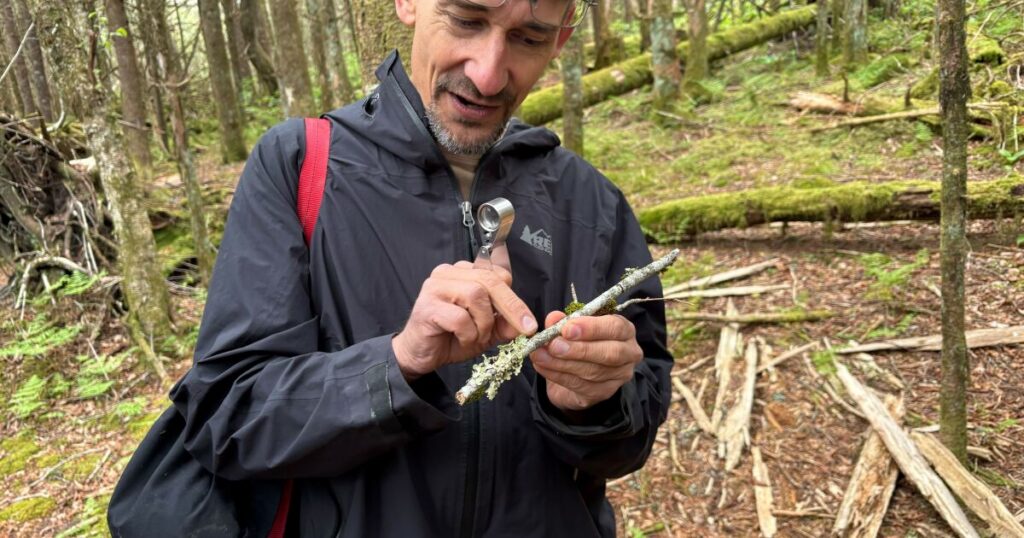
Accompanying Hollinger was Laura Boggess, a fellow volunteer and lichenologist, who used a magnifying lens to identify over seventeen species of moss and lichen on just one side of the tree. The team, known as the Gang of Retirees in Search of Life’s Diversity (GRISLD), is dedicated to documenting the park’s biodiversity, particularly in light of recent federal budget cuts affecting science agencies and park staff.
The group’s efforts contribute to the All Taxa Biodiversity Inventory (ATBI) project, which aims to catalog every species within the park. Will Kuhn, who oversees scientific research at Discover Life in America, a nonprofit managing the ATBI, explained, “We’re up to over 22,000 species of everything that has been documented here in the Smokies.” Astonishingly, over 1,000 of these species are new to science, though Kuhn believes this is just a fraction of the park’s true biodiversity.
Despite the excitement of discovering new species, Kuhn emphasizes the under-researched smaller organisms such as lichens, mites, and fungi. These are often overlooked compared to larger, more charismatic species.
GRISLD volunteers, like Boggess and Hollinger, often find themselves in less accessible parts of the park, gathering data year-round, unlike other researchers who primarily visit during warmer months. Their work is crucial in observing species that are most active outside the typical research seasons.
Paul Super, a retired biologist and volunteer, expressed concerns over the changing park ecosystem. The loss of tree species like elms and hemlocks, coupled with the potential threat to the spruce-fir forest, highlights the impact of climate change. Super noted that these high elevation areas play a vital role in regulating moisture, which is crucial for downstream water supplies.
In response to these challenges, local nonprofits like Discover Life in America collaborate with the National Park Service, filling gaps in research and funding. During the 2025 government shutdown, these organizations helped keep the park operational.
For Boggess, the meticulous process of documenting species is a crucial part of understanding climate change’s impact. “The small ways, the paying attention, the naming of a species, which isn’t a small thing, but it’s like an accumulation of small, cooperative creation,” she said.
As the group wrapped up their exploration, they stumbled upon a rare parasitic fungus, further highlighting the park’s incredible yet fragile biodiversity. Each discovery fuels their commitment to preserving the ecosystem for future generations.