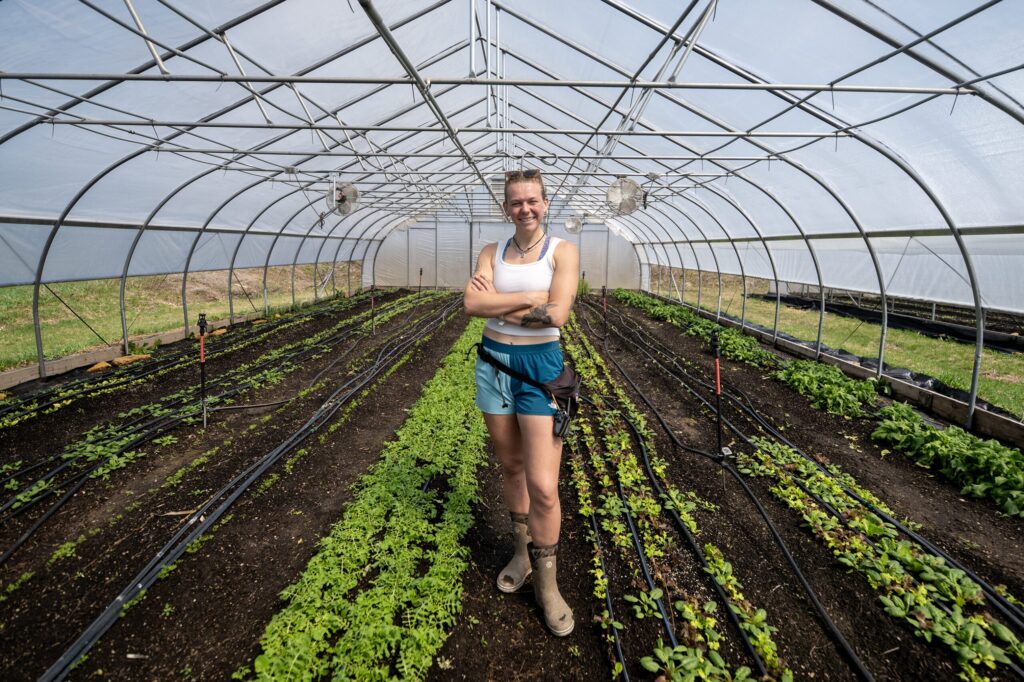
In the rolling fields of southern Wisconsin, Patty Grimmer is redefining what it means to be a community-supported agriculture (CSA) farmer. Operating from just 4 acres at Wonka’s Harvest, she has found innovative ways to supply fresh produce to local markets and consumers.
Grimmer started her journey in 2020 with a focus on community-supported agriculture, a model that gained popularity in the Midwest during the 1990s. This system allows people to invest in a farm by purchasing a share of its produce upfront, which is then delivered in weekly boxes throughout the growing season.
Adapting to Modern Consumer Needs
“It’s an easy avenue for getting some capital up front,” Grimmer explained. “People sign up for CSA, you know, in January, February or March when we need the capital to buy seeds, buy soil.” However, Grimmer realized the need to adapt the CSA model to attract a younger, more diverse customer base. She introduced flexible payment options, allowing customers to pay weekly and even choose a “pay what you can” pricing model.
Recognizing the shift in consumer habits towards convenience, Grimmer’s approach offers flexibility that appeals to modern shoppers. “You can get your groceries delivered to you in a matter of hours while you sit on your couch and pick what you want to pick,” she noted.
Transforming the CSA Experience
Innovations in the CSA model are being embraced by multiple farms, many of which have adopted online platforms that allow members to customize their weekly boxes and manage payments. Some have even transitioned to a credit system, offering customers the freedom to determine when they receive produce.
Sadie Willis of FairShare CSA Coalition remarked on this evolution, noting that the relationship between farms and customers has become more transactional. Yet, the community-supported ethos remains intact. “Even if those customers are saying, ‘Hey, I want to pick up my box at my local brewery instead of having to drive over to your farm to get it,’” Willis said, the essential support system persists.
As health and wellness trends continue to rise, CSAs are uniquely positioned to capitalize on this demand by promoting organic and sustainable farming practices. Willis observed, “People are more than ever curious about what’s in their food, where it came from, how it was grown and processed, or not processed at all, and they really want to focus on aligning their finances with well-being for their families.”
Balancing Tradition and Innovation
Despite these advancements, some longtime CSA advocates express concern over the departure from traditional models. John Hendrickson, a farm viability specialist at the University of Wisconsin-Madison, emphasized the original intent of CSA as a shared risk between farmer and consumer. However, he acknowledged that the model has evolved to accommodate modern consumer expectations.
Liz Graznak of Happy Hollow Farm in Missouri has cautiously incorporated flexibility into her CSA offerings. While she allows monthly payments and minor adjustments to the produce boxes, she maintains boundaries to preserve the essence of CSA. “That does not fit what CSA is,” Graznak asserted. “For me, CSA embodies eating seasonally, supporting the farm that is feeding you, and you know, I’m not Amazon.”
Finding the equilibrium between attracting new customers and staying true to community-supported roots remains a challenge for CSA farmers. As the landscape of consumer preferences continues to shift, the future of CSA will likely see further adaptations while holding onto its foundational values.
This story was produced in partnership with Harvest Public Media, a collaboration of public media newsrooms in the Midwest and Great Plains. It reports on food systems, agriculture and rural issues.