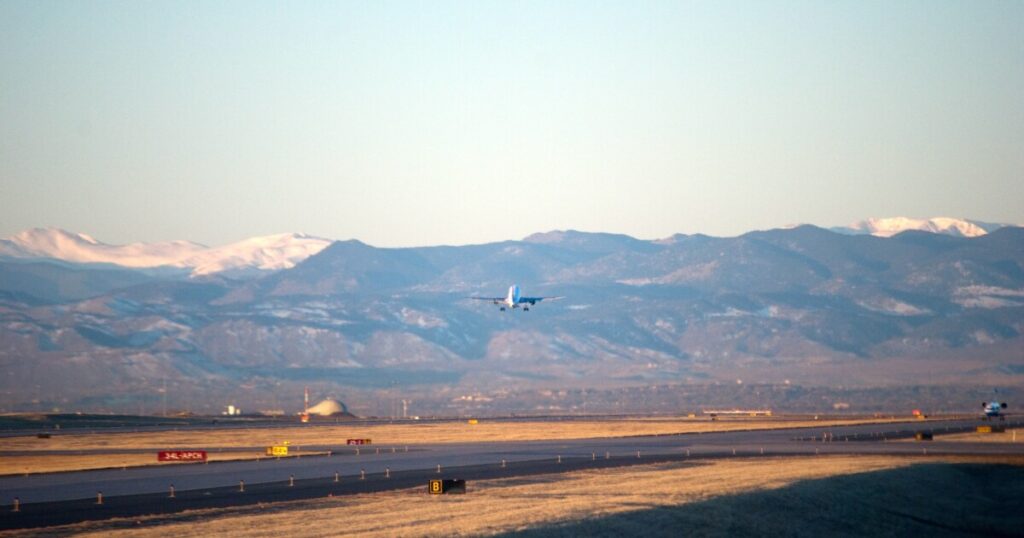
Airports across the Mountain West have been identified as some of the most turbulent in the United States, according to a recent study by Turbli. Out of the top 10, eight are located in this region, where the mountainous terrain contributes to unstable flight conditions. Leading the list is Denver, followed by Bozeman, Montana, and Albuquerque, New Mexico, while Salt Lake City and Jackson, Wyoming, round out the top five. Other notable mentions include Las Vegas, Reno, and Boise.
These turbulence challenges are primarily due to geographical features. As winds pass over mountain ranges such as the Sierra Nevada and the Rockies, they can generate “mountain wave” turbulence, creating atmospheric ripples that impact aircraft even far from the airport.
Jason Ambrosi, a commercial pilot and president of the Air Line Pilots Association, International, emphasized that pilots are well-prepared to handle these situations. “We receive training on strategies to avoid and mitigate turbulence, how to fly through it. Our airplanes are built to withstand turbulence,” Ambrosi explained. “It’s just something that pilots mitigate on a daily basis. We plan for it and brief the passengers that we might have a little bit of a choppy ride in or out.”
He also noted that pilots rely on forecasting tools, specialized training, and operational adjustments to ensure a safe journey through turbulent skies.
The attention on turbulence comes as experts explore the potential impact of climate change on flying conditions. Some research indicates that turbulence might increase in frequency as global temperatures rise, although advancements in forecasting and avoidance technologies are concurrent.
This report is a product of the Mountain West News Bureau, a collaboration among public media organizations, and supported by the Corporation for Public Broadcasting and other benefactors.