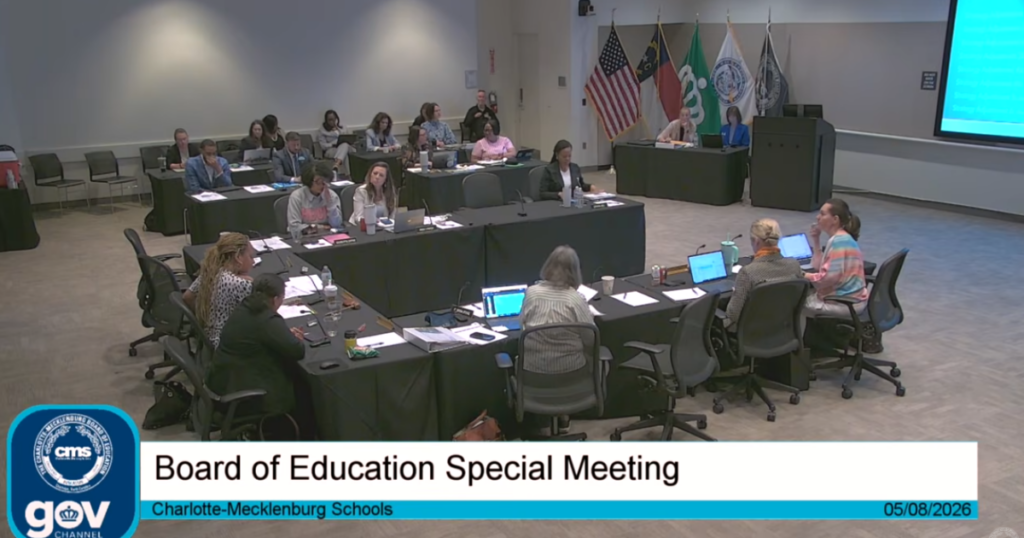
The Charlotte-Mecklenburg Schools Board of Education and Superintendent Crystal Hill are currently facing significant challenges in finalizing the district’s budget for the next academic year. In a tense meeting that lasted almost five hours, the board and Hill struggled to find common ground.
Superintendent Hill, whose initial $2.1 billion budget recommendation was dismissed by the board in an 8-1 vote on April 28, expressed her frustration over the tight deadline to provide a revised budget. She clarified that the proposal she presented on Friday was not her own suggestion but rather a compilation of resource reallocation options.
“There’s no way that I could have come up with another recommendation in a week,” Hill stated. “That’s not my leadership style. My leadership style is going to the people that are closest to the work and getting feedback. … So what you’re seeing today is absolutely not my recommendation.”
Board Chair Stephanie Sneed voiced her disappointment regarding the lack of clear recommendations from Hill, particularly after discussions held earlier in the week.
“I don’t know what we’re doing here,” Sneed remarked. “I’m having a hard time wrapping my head around what the purpose of the exercise is, because what I’m hearing is the superintendent’s recommendation is not going to change.”
With time running short, district officials aim to present a revised budget by Monday, May 11, review it with Hill on Tuesday, May 12, and submit it to the Mecklenburg County Board of Commissioners on Wednesday, May 13. The final budget request is due by Friday, May 15.
Funding Context
The district’s budget is heavily reliant on state funding, which covers base teacher salaries and other expenses based on student numbers. However, with CMS experiencing a decline in enrollment, dropping to an estimated 139,000 students from roughly 147,000 a decade ago, financial adjustments are necessary.
Approximately $700 million of Hill’s proposed budget is expected to come from Mecklenburg County, with a request for an additional $31.1 million over the previous year. On Friday, Hill and her staff suggested minor changes such as increasing class sizes in some schools to redistribute 95 teachers to higher-need areas and reallocating $2.4 million from a school culture program to social-emotional learning and family engagement initiatives. Hill emphasized that these were not her personal recommendations.
“What I am saying to you is Crystal Hill will do anything that the board asks me to do,” she said. “I cannot in good faith do anything that is going to put this district in a bad financial position. When we’re tinkering with staffing, it might go smooth sailing today, but you’re either going to pay now, or we’re going to pay later.”
The absence of a state budget has further complicated the situation, leaving teacher pay raises uncertain. Chief Financial Officer Kelly Kluttz warned that depending on the state’s final decision, CMS might need to introduce additional cuts.
The current budget assumes a 3% increase in teacher salaries, but Kluttz noted that if the state approves raises of 6%, 7%, or even 8%, CMS would have to reallocate funds to cover these increases.
“Planning too conservatively will leave us unprepared if the state approves a higher increase,” Kluttz said. “Planning too aggressively could require decisions that are difficult to unwind if the increase does not materialize. There are risks in both.”
Board Frustration
The prolonged budget process, now in its sixth month, has left several board members feeling frustrated, citing a lack of clear communication from district staff.
Board member Shamaiye Haynes conveyed her dissatisfaction, saying, “I feel a certain type of way. I feel like people have really played in my face for a few months about this.”
Addressing the staff directly, Haynes added, “You definitely have the upper hand in terms of putting something up on a screen and allowing the public and the world to see how stupid we are. That is not welcomed in this process.”
Charlitta Hatch, another board member, criticized the presentation’s tone, suggesting it implied board members lacked understanding.
“I think there is an undertone that this might be above board members’ understanding,” Hatch commented. “That’s not the case. We understand what a budget is. We know what one-time funds are and what recurring funds are.”
The meeting concluded without a clear direction on what changes Hill and her team will propose next week.