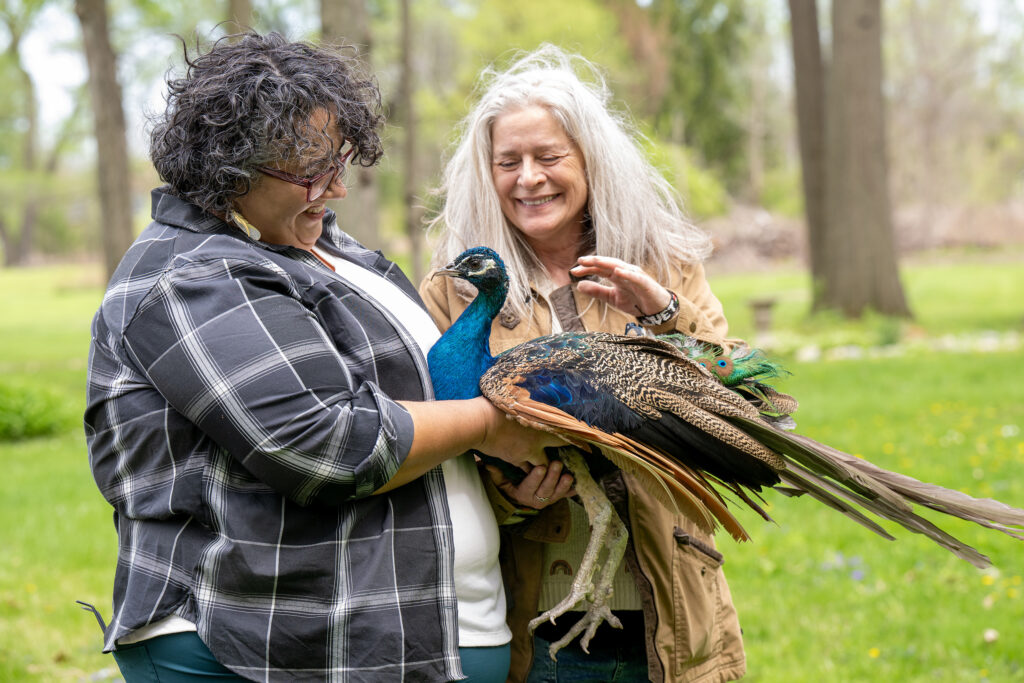
Birds play a unique role in the lives of some, offering companionship and teaching subtle life lessons. Geila Rajaee and K Rivet Amico, both instructors at the University of Michigan’s School of Public Health, have found a shared passion for these feathered creatures, forming a unique bond over their mutual love for avian friends.
Rajaee, who lectures in Health Management and Policy, grew up surrounded by birds on a family property in Canton, rich in peacock heritage. This love for birds is rooted in tradition, intertwining her Iranian background and her father’s passion. Today, she continues to live on her family land, nurturing a growing flock.

Feathered Friends of All Kinds
Rajaee shares her mornings with Hero, an 18-year-old peacock who enjoys the freedom of the yard and exclusive barn space due to his seniority. “He’s got a little space in the barn that’s just his,” Rajaee notes, highlighting Hero’s comfortable lifestyle.
The pandemic brought new opportunities for Rajaee, who began incubating peacock eggs. Over the years, her flock expanded significantly. Today, her avian family includes chickens, pigeons, and two parrots named Meiko and Taco, each with their own charming quirks.

Rajaee also integrates her love for birds into academia, using bird names as passwords for attendance quizzes in her course, subtly bringing her passion into her professional setting.
Intentional and Accidental Avians
Amico’s journey is somewhat parallel but distinct. Residing on a 25-acre farm near Brighton, she initially planned to raise chickens with her family. However, her flock grew unexpectedly with the addition of ducks. “We accidentally have ducks. We ‘on purpose’ have chickens,” she explained, describing how her collection expanded due to a neighbor’s request.
This unplanned growth is illustrative of how both women embrace the unexpected joys and challenges of bird ownership.
The Therapeutic Nature of Birds
The responsibilities of caring for these birds provide both women with a form of therapy. Amico appreciates the tangible results of chores, contrasting them with academia’s often intangible outcomes. “The chores … have an immediate result, and that’s nice because in academia we often don’t have that,” she states.
Rajaee finds solace and humor in observing her birds’ antics, providing a much-needed mental break from her professional duties. “I like being able to get out of my head for a little bit,” she shares.

Both professors emphasize the importance of empathy and understanding when tending to their animals, lessons they carry into their professional lives. Amico, whose research delves into HIV prevention and treatment, parallels her approach to farming with her scholarly work, focusing on collaboration and presence rather than control.

Life Lessons in Unexpected Places
Coming from a background as a clinical healthcare chaplain, Rajaee’s transition into public health research involves examining spiritual distress’s impact on chronic disease. A moment of peaceful reflection with a duck near Princeton inspires her work, serving as a reminder of life’s simple beauties.
“I’m really grateful for the moments to be able to stop, slow down, and watch some ducks or my peacocks jump around and be weirdos,” Rajaee expresses, highlighting how these experiences serve as her own form of spiritual resilience.