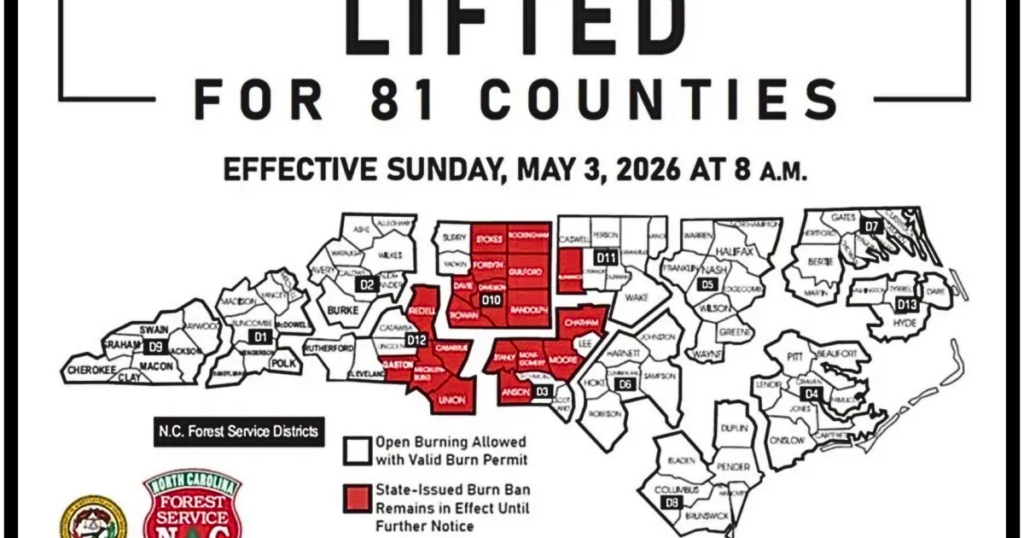
Following weeks of fire restrictions, Western North Carolina residents received some welcome news as the N.C. Forest Service announced the lifting of a statewide open burn ban for 81 counties, effective from 8 a.m. on May 3. Despite the easing of restrictions, the drought conditions that led to the ban persist, prompting officials to urge continued caution.
The burn ban, which had been in place since March 28 due to hazardous conditions, resulted in the cancellation of nearly 18,000 burn permits across the state.
Agriculture Commissioner Steve Troxler stated in a press release, “The recent rainfall has provided some relief and has moderated fire danger enough for us to lift the ban on open burning in 81 counties. However, we’re still in the thick of spring wildfire season when conditions can change quickly and frequently. We still need rain to move us forward with drought recovery.”
The 100-foot Rule
While the state ban has been lifted, local restrictions still apply, particularly the rule prohibiting burning within 100 feet of an occupied dwelling. This rule falls under local fire marshals’ jurisdiction. In Buncombe County, the local restriction was also lifted starting at 8 a.m. Sunday. Residents elsewhere should verify with their local fire marshal regarding burning near structures.
To comply with regulations, individuals must acquire a new burn permit since all previously issued permits were voided when the ban was imposed. Permits are available online at apps.ncagr.gov/burnpermits or from authorized agents. For inquiries, Buncombe County residents can contact the Open Burning Hotline at 828-250-6767 or visit buncombenc.gov.
U.S. Drought Monitor/USDA/NOAA
The Ongoing Drought Challenge
Despite the lifted ban, Troxler cautioned that the situation remains critical. The latest drought map, issued on April 28, highlights that Western North Carolina is still entrenched in extreme drought, the second-most severe category. Conditions have worsened recently, with the drought expanding further into the Piedmont and central regions.
“With the persistent drought, it’s important for all of us to use extreme caution when handling potential ignition sources such as machinery and motorized equipment,” Troxler said. “When in doubt, lean on your N.C. Forest Service county ranger’s office for guidance and best practices.”
For local inquiries, contact your N.C. Forest Service county ranger through ncforestservice.gov/contacts. For more insights into the drought’s impact on the region, refer to previous coverage here.
Stay updated on local drought conditions at ncdrought.org, check fire danger forecasts at climate.ncsu.edu/fire, and subscribe for weekly drought updates at go.ncsu.edu/droughtlist.