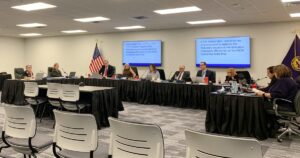
In a time of financial uncertainty for public universities nationwide, the University of Nebraska at Omaha (UNO) is taking proactive steps to bolster student support and workforce readiness. These efforts were detailed during a campus forum on Monday, which gathered university leaders, faculty, and students to discuss budget challenges and strategic plans.
Faced with a less-than-expected state funding allocation last year, the NU Board of Regents made the difficult decision to implement $20 million in cuts across the university system and raise tuition by 5%. As a result, UNO is grappling with a $1.9 million structural deficit.
Chancellor Joanne Li cautioned attendees that financial pressures are likely to persist. “It is still a survival game in 2026,” Li remarked. Highlighting the state’s projected $874 million deficit, she noted, “It could go up. Sure, it could go down, but usually it’s going up, right? So for us as a metropolitan university, we have to recognize there will be immense price pressure coming into our operation.”
Despite these challenges, the university is committed to fulfilling the needs of its students and supporting Nebraska’s workforce. Li highlighted the launch of an Artificial Intelligence program last fall as a significant step in this direction.
Under the NebraskaCYBER MATRIX initiative, UNO has developed an AI-enabled Security Operations Center and a cybersecurity bootcamp. This initiative aims to address the increasing demand for skilled professionals in the cybersecurity field.
The forum also brought attention to UNO’s upcoming competency-based education program. Designed for working professionals, career changers, and nontraditional students, this program allows individuals to progress by demonstrating skills rather than spending a fixed time in a classroom setting.
“I want to say that we must always honor our core,” Li emphasized. “What is our North Star? We are the economic equalizer. We are the workforce development engine.”