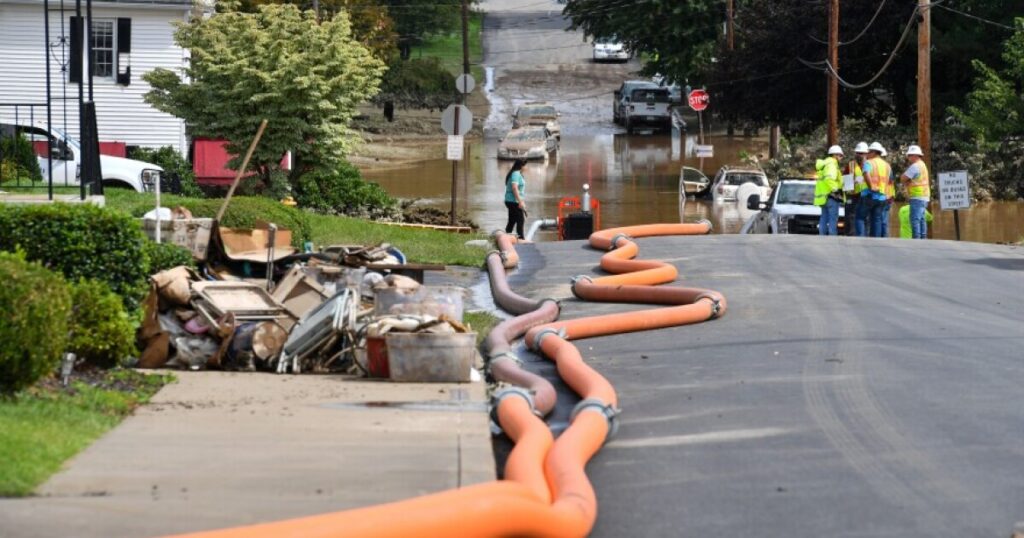
As Scranton continues to grapple with the aftermath of devastating floods, the city awaits crucial federal funding to bolster its flood defenses. The uncertainty surrounding the Building Resilient Infrastructure and Communities (BRIC) grants has caused concern among local officials, fueled by ongoing political deadlock over immigration policy.
Scranton officials applied for BRIC grants following severe flash floods in September 2023, which caused significant damage across the region. However, the process has been stalled, with Mayor Paige Cognetti stating, “We’ve tried to get in touch with FEMA.” The Federal Emergency Management Agency, a part of the Department of Homeland Security, has been hampered by funding issues since February.
Funding Stalemate and Political Tensions
The Senate has passed a spending bill to support FEMA, but the House of Representatives has yet to act. Cognetti expressed frustration, noting, “They are shut down, so there is not a lot of information there. I certainly hope that things are back on track after an unnecessary year, additional year, of waiting for these families to get back to their lives and rebuild their financial futures.”
Congressman Rob Bresnahan, representing Pennsylvania’s 8th district, echoed these concerns, emphasizing the importance of BRIC funding for the region. “We have been very vocal to the administration, to FEMA, that BRIC funding has significant impacts to Pennsylvania’s 8th congressional district,” he stated. Notably, Cognetti and Bresnahan are political rivals in the upcoming congressional elections.
The Aftermath of the Flood
The 2023 flood wreaked havoc on infrastructure and private properties in Scranton, notably in North Scranton and Keyser Valley. The city has sought $2.7 million to acquire and demolish 18 properties and three vacant lots severely affected by the disaster. An additional $75,001 is requested for updating building codes related to flooding.
FEMA has indicated that the funding will be forthcoming, though it may take up to 18 months. Mayor Cognetti recalled, “Then we saw in April of 2025 that the Trump administration cut the BRIC program.” A lawsuit by 22 states, including Pennsylvania, successfully reinstated the program.
Bresnahan’s Advocacy for BRIC Funding
Representative Bresnahan has been proactive in seeking clarity on the funding situation. He has been in contact with FEMA to determine if Scranton must reapply for the promised aid. Bresnahan criticized the administrative changes that have delayed the process, asserting, “What’s not fair is Northeastern Pennsylvania communities are being swept up in higher level administration changes.”
He has also introduced legislation aimed at safeguarding the BRIC program from future cuts. Bresnahan emphasized the importance of federal investment in critical infrastructure, noting, “There is a responsibility of the federal government to provide the necessary investment into critical infrastructure systems.”
Securing the Future
Looking ahead, Mayor Cognetti plans to use the funding to install stormwater collection infrastructure or create recreational spaces, such as a soccer field, once the affected properties are demolished. “It’s not about just the families and making sure that they get whole. It’s also about protecting our first responders and not sending them in harm’s way unnecessarily,” she explained.
The broader implications of inadequate infrastructure investment are significant, as Bresnahan pointed out, “There’s over a trillion dollars of property that are protected by levies in the United States.”
Scranton was included among 656 projects selected for the 2023 BRIC grant cycle. “It’s been very frustrating to have this extra year in the middle that was so unnecessary,” Cognetti remarked, adding that if necessary, local tax dollars would be used to progress the projects.
The Pennsylvania Emergency Management Agency (PEMA) will highlight the Disaster Recovery Assistance Program (DRAP) Friday at 11 a.m. at the football field adjacent to 2310 Jackson St., in Scranton.
The program helps individuals and families without other means of support get back on their feet after a disaster, according to the state. It is expanding in 2026 to supplement county and municipal resources with restoring public infrastructure to pre-disaster condition, removing debris and taking emergency protective measures that are not covered by insurance or another funding source.
DRAP provided over $42,000 in grants to seven Lackawanna and Wyoming county households after the September 2023 flood.