In the wake of Hurricane Helene, a funding misstep could leave over 100 Asheville homeowners ineligibly stranded from a recovery program designed to aid low-income and socially vulnerable residents. A year since the City Council’s decision, concerns and misconceptions about the allocation of disaster recovery funds have surfaced, prompting a potential reevaluation.
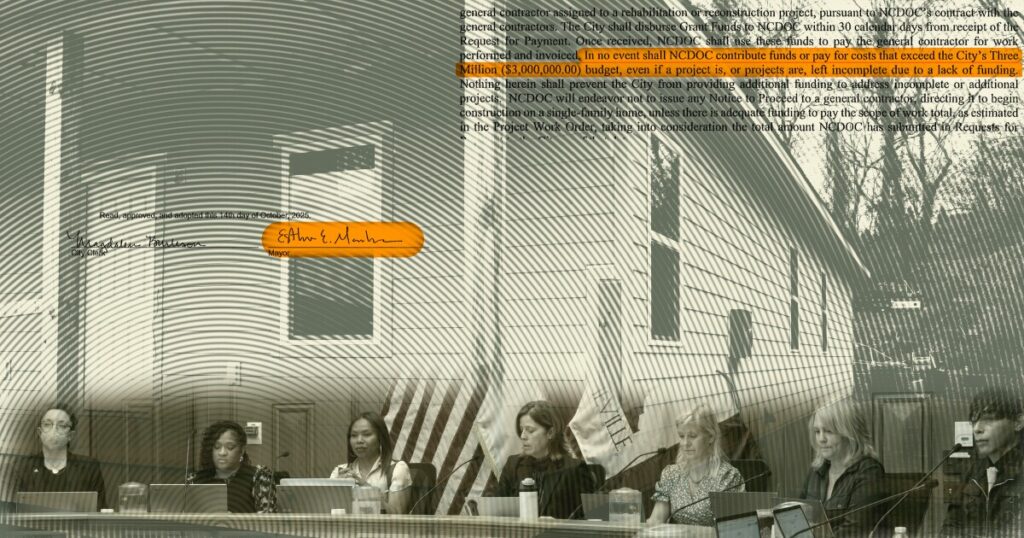
Asheville City Council had allocated a mere $3 million for home repairs, enough for just eight homes, despite the broader pool of $800 million set aside by the state for similar recovery initiatives. This decision comes from a $225 million federal Department of Housing and Urban Development (HUD) grant meant to help the city recover from natural disasters.
The misunderstanding seems to have arisen from the assumption that local homeowners would qualify for the state’s funds, easing the city’s financial burden. However, this coordination with the state’s Renew NC program was only intended to streamline administrative processes, not to co-fund repairs.
James Shelton, who manages Asheville’s HUD grants, stated, “I feel like we made that clear to Council members,” asserting that the council was informed about the limitations of state funding for local repairs. Elma King, the program manager for the city’s HUD funds, echoed this sentiment, highlighting the delineation of administrative and construction responsibilities between state and city.
However, some council members, like Sage Turner, expressed surprise at these limitations, recalling a misunderstanding that state funds would supplement city efforts. Turner noted, “It came as a shock,” referencing the minimal $3 million allocation for single-family repairs compared to $28 million for multi-family housing.
State vs. City Funding Priorities
The disparity in funding priorities between the state and city highlights a broader issue. While the state dedicated $800 million of its HUD grant to housing repairs, Asheville allocated $31 million to housing, with the bulk directed toward new affordable housing rather than repairs.
Stephanie McGarrah, leading the state’s Renew NC program, clarified that the state’s funds were insufficient to extend aid to Asheville homeowners. “ What we’re finding across the state is that we do not have enough money,” she remarked, emphasizing the financial constraints faced by both state and city programs.

The city might amend its Action Plan to allocate more funds towards single-family home repairs, yet this process involves a public hearing and vote, delaying the distribution of aid. The urgency for a funding shift becomes apparent as the state and city grapple with limited resources and high demand.
Ongoing discussions between state and city officials aim to address the funding gap, but as McGarrah highlighted, “The city of Asheville is struggling with the same thing that the state is struggling with on the CDBG-DR front, which is that we do not have enough money.”