
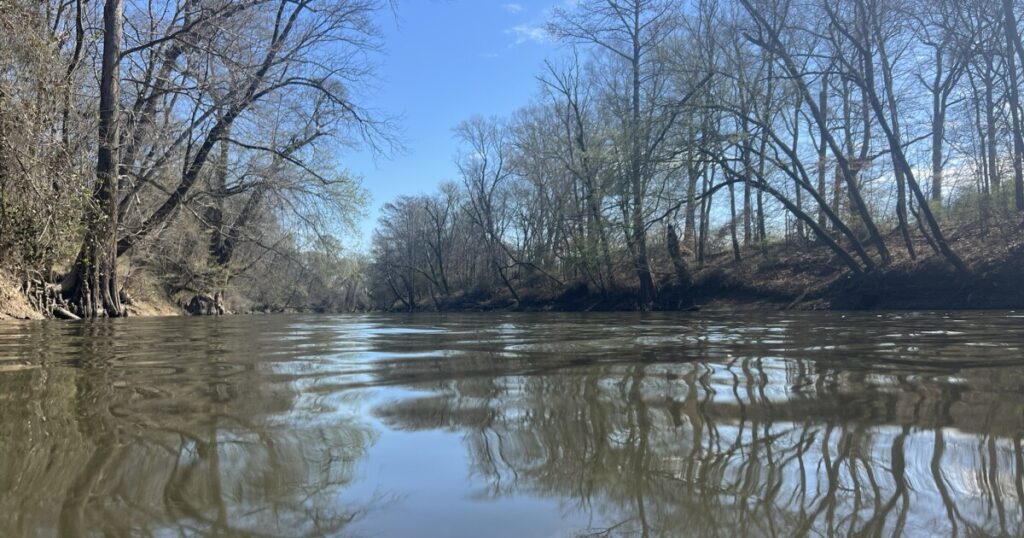
The tranquil flow of the Tar River paints a serene picture on a spring day. Katey Zimmerman, sitting on a dock meant for launching kayaks and canoes, reflects on the river’s surface through her sunglasses.
“Water is a finite resource, especially freshwater,” says Zimmerman, who serves as the Pamlico-Tar Riverkeeper with the nonprofit organization Sound Rivers.
Zimmerman has been devoting considerable time to opposing a proposed data center in Edgecombe County. This facility would require 900 megawatts of energy, equivalent to the power consumed by approximately half a million homes.
The center plans to source its water from Rocky Mount, which draws from the Tar River. Nearby, water gushes from a large, concrete pipe—a discharge from a city-run wastewater treatment facility.
“I’m concerned over what (this project) means for water availability in the Tar River,” Zimmerman remarks. “We don’t have any concrete information or details from the company about how much water they plan to use.”
According to Edgecombe County Manager Eric Evans, the developer, Energy Storage Solutions, estimates water usage at about 500,000 gallons per day. However, the County has halted project consideration until the company provides proof of secured financing.
Energy Storage Solutions did not respond to requests for comment from WUNC News.
In this 6-part series, BPR, the NC Newsroom, WFAE, and WUNC explore North Carolina’s accelerating data-center boom and its real impact on local communities.
Through on-the-ground reporting, document reviews, and conversations with residents, the series examines how Big Tech is reshaping small towns, consuming vast amounts of power, and striking deals that aren’t always clear. It explores who benefits, who bears the cost, and why North Carolina has become an appealing target for server farms despite modest public scrutiny. By following the money, the energy demands, and the promises made to communities, the project aims to reveal what’s at stake as the cloud moves into the state’s backroads.
Zimmerman is not isolated in her concerns. Various North Carolina communities are voicing worries about data centers’ effects on local water utilities, quality, and availability.
Major tech firms such as Meta, Google, and Microsoft have pledged to replenish more water than they use through sustainable practices and local stewardship projects.
Water quality: PFAS Concerns
Data centers utilize water in several ways: powering energy facilities such as coal plants, supplying energy to data centers, and manufacturing computer chips. However, most concerning for North Carolina communities is the water needed for cooling data centers. The cooling systems, critical for preventing equipment from overheating, vary depending on several factors.
Zimmerman highlights the potential for water pollution from data centers.
“There are a lot of concerns over specific contaminants that are introduced to the water during the cooling process,” Zimmerman warns.
Some data centers incorporate PFAS, or “forever chemicals,” in their cooling processes. PFAS are already prevalent in other North Carolina waterways and are linked to health issues such as reduced fertility and increased cancer risk.
“It seems like there would be the possibility of PFAS being discharged into the Tar River, which is what we don’t want to see,” Zimmerman adds.
Jonathan Kalmuss-Katz, a senior attorney with Earthjustice, acknowledges the lack of comprehensive studies on PFAS use in data centers.
“Can I point to an example where this data released (this) PFAS to this utility? No, but that doesn’t mean it’s not happening,” says Kalmuss-Katz. “That just means that there’s not enough information and not enough disclosure about what these data centers are actually releasing.”
Water availability: Climate Change’s Impact
North Carolina is experiencing moderate to extreme drought conditions, worsened since last August. Climate change has made rainfall more erratic, complicating the replenishment of water sources like aquifers and reservoirs.
“Climate change is really removing the safety net from our water supplies,” says Corey Davis, Assistant State Climatologist. “A reservoir operator may not know whether they need to keep the water levels higher in case of a drought, or lower in case of heavy rainfall.”
Davis introduces the concept of “weather whiplash,” where extreme wet and dry periods occur with little warning, impacting water resource management.

Courtesy of North Carolina Weather Authority
Heavy rainfalls may not replenish groundwater effectively due to surface pooling. Additionally, North Carolina’s population has more than quadrupled over the last century, further straining water resources as data centers demand more water.
“Over the last 100 years North Carolina’s population has more than quadrupled,” Davis notes. “So then when you add in things like data centers, that are not people but machines, that are consuming more water, certainly that adds to the stress that water systems can face.”
Local water utilities: Balancing Needs
Data centers’ water consumption varies based on factors such as size, location, and cooling systems. For instance, Meta’s data center in Forest City used around 4.2 million gallons of water in 2024, while a proposed 300 megawatt data center in Apex was projected to use up to 1 million gallons per day before its cancellation.

Courtesy of American Rivers
Jonathan Jacobs, Apex’s water resources director, illustrates how data centers rely on local utilities. The canceled project planned to use treated wastewater rather than potable water to conserve finite drinking resources from Jordan Lake.
“We have been very firm on no domestic water to protect our finite drinking water resource there at Jordan Lake,” Jacobs states.
Jacobs emphasizes his duty to supply water to residents while considering downstream impacts. “Fayetteville and Harnett County are all dependent on our wastewater stream just as much as we are from Burlington and Greensboro and all the towns upstream from us that provide water to the Haw River that feeds into Jordan Lake,” he explains. “We want to make sure that our downstream partners are getting the anticipated return that we always intended to serve the (Cape Fear) basin.”
As Jacobs notes, water interconnects everything, guiding local decisions to balance rapid technological growth with limited natural resources.



