
North Carolina Residents Concerned About Fracking and Energy Costs Amid Data Center Boom
In the tranquil surroundings of Lee County, North Carolina, Sheila Sherrick’s pig, T-Bone, finds corn more enticing than returning to her pen. Meanwhile, a new kind of attraction is drawing attention in the area: potential fracking to support energy demands for burgeoning data centers.
Sherrick’s home, located near the Deep River and not far from Butler Well No. 3, stands as a witness to the region’s untapped natural gas reserves. However, with companies like Deep River Data eyeing these resources to power data centers, concerns about environmental and economic impacts are rising.
Inside Climate News reports that Deep River Data, linked to cryptomining, aims to harness these natural gas reserves. Sherrick voices her apprehension, saying, “We’d be sitting in the dark if it goes up any higher,” as she manages her home on a fixed income with her children.
Data centers are notorious for their substantial energy needs, with some consuming as much power as entire power plants. This growth is driving North Carolina’s largest utility, Duke Energy, to propose a significant capital plan to accommodate the demand, as highlighted in a report by the Electric Power Research Institute.
Despite data centers comprising only a fraction of new projects, they account for a significant portion of North Carolina’s projected energy demand, as noted in the NC Energy Policy Task Force Report.
‘You asked for 100, we built 100’
Utilities across the nation are adopting large-load tariffs to ensure that data centers and other high-demand facilities pay their fair share. Jeremy Fisher from the Sierra Club explains this system, which ensures utilities only build necessary infrastructure.
Scott Castle of Dominion Energy illustrates how a 100 megawatt data center would pay for 85% of its contracted capacity, whether used or not. However, Duke Energy resists new tariffs, arguing that existing rate schedules suffice, despite concerns from experts like Nick Jimenez of the Southern Environmental Law Center.
Jimenez emphasizes the need for equitable rate structures to ensure that data centers contribute fairly to the grid’s costs. Duke Energy spokesperson Bill Norton notes that data centers could potentially lower overall costs, but only if they drive economic development as expected.
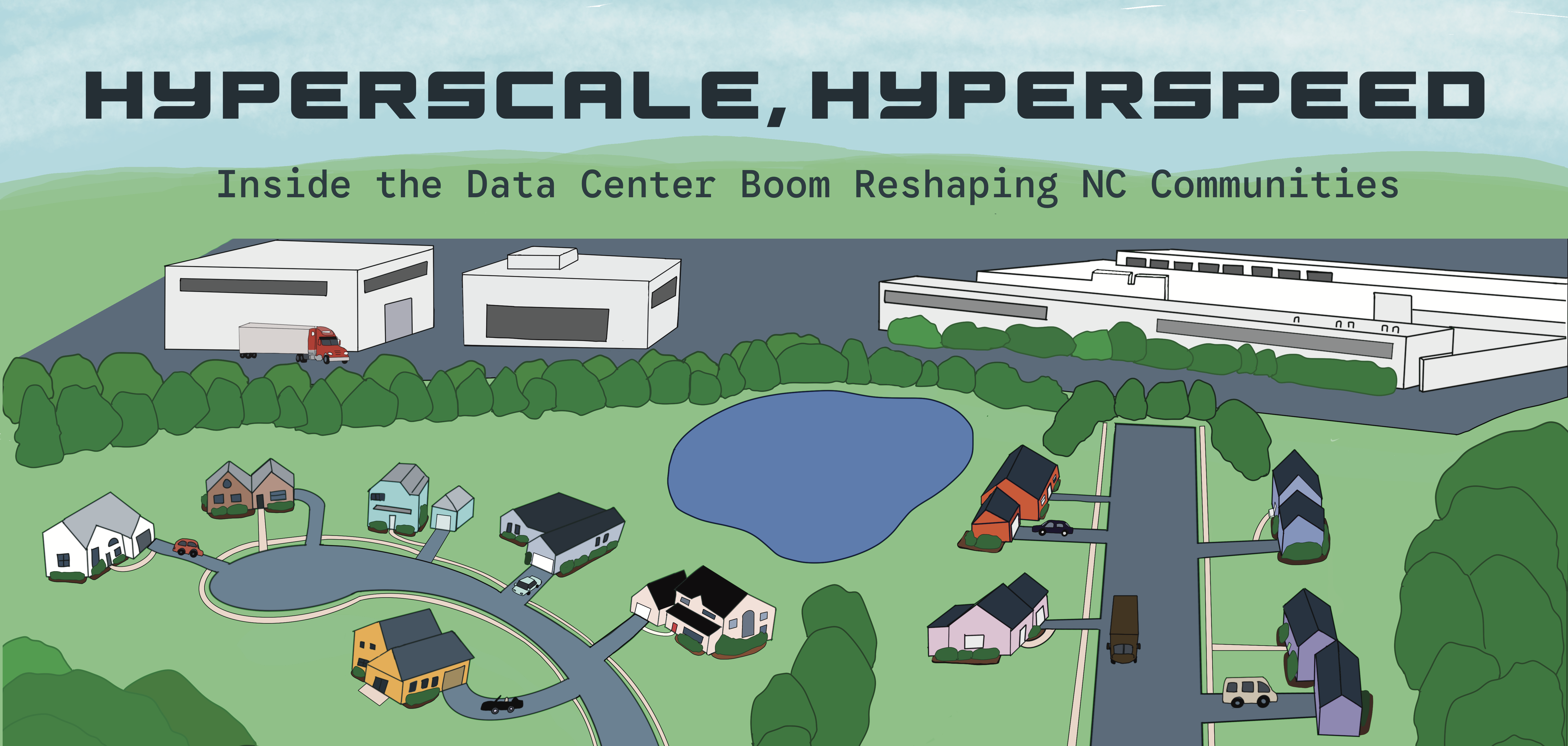
In this 6-part series, BPR, the NC Newsroom, WFAE, and WUNC explore North Carolina’s accelerating data-center boom and its real impact on local communities.
Through on-the-ground reporting, document reviews, and conversations with residents, the series examines how Big Tech is reshaping small towns, consuming vast amounts of power, and striking deals that aren’t always clear. It explores who benefits, who bears the cost, and why North Carolina has become an appealing target for server farms despite modest public scrutiny.
Duke Energy utilizes contracts with large customers, incorporating elements of a large-load tariff. However, without state regulation, there’s concern about building infrastructure without guaranteed demand.
Data centers are fueling a changing energy mix
While utilities like Duke Energy have various strategies to manage load growth, data centers’ inflexible energy requirements are pushing them to rely more on fossil fuels. Duke Energy has proposed significant natural gas projects to meet this demand, raising questions about cost distribution and environmental impact.
Jimenez highlights the potential burden on ratepayers due to increased natural gas use, while Fisher warns of exposure to volatile fuel costs.
Hitting the pause button
Amid these discussions, residents like Sherrick are advocating for county-level moratoriums on new developments until the economic and environmental impacts are adequately assessed. In March, over 100 residents gathered to urge local commissioners to consider a moratorium to protect their community’s interests.