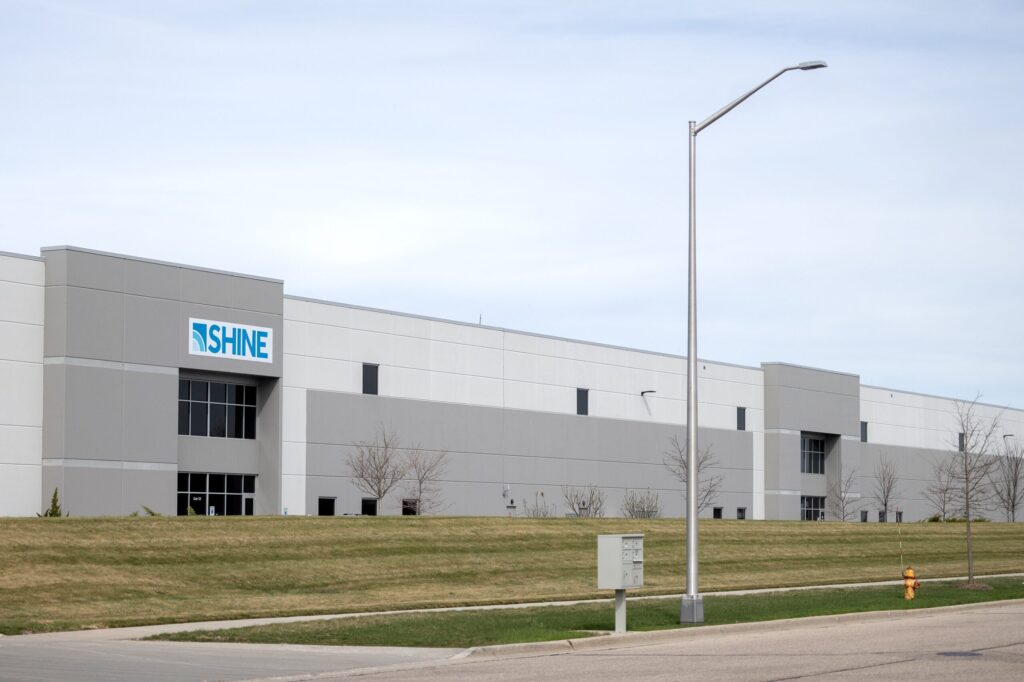
In a significant development for Janesville, a federal loan exceeding $200 million is set to expedite the completion of a state-of-the-art medical isotope manufacturing facility. This project is poised to bolster the local economy by generating approximately 150 full-time employment opportunities.
The U.S. Department of Energy disclosed its conditional commitment to provide the loan to SHINE Technologies, aiding the advancement of the isotope production plant known as “Chrysalis.”
The facility, once operational, will utilize a nuclear fusion-based method to produce medical isotopes. The Department of Energy notes that these isotopes are crucial for the daily medical needs of 40,000 individuals, particularly in diagnostic imaging and cancer treatments.
The Janesville facility is set to become the sole domestic commercial producer of molybdenum-99 (Mo-99), the most widely used diagnostic isotope globally.
During a recent media briefing, officials highlighted that the majority of the U.S. isotope supply is currently imported, and the Janesville project aims to reduce this dependency. Gregory Beard, director of the U.S. Department of Energy’s Office of Energy Dominance Financing, stated, “It’s going to support about 150 full-time jobs after the 200 jobs to build the project. Once it’s up and running, this important technology will help make medicine more affordable in the United States.”
Beard further elaborated that the loan, potentially reaching $263 million, would span approximately 15 years, offering more favorable terms than conventional bank financing.
Several legal, environmental, and financial prerequisites must be met by the Department of Energy and SHINE before the loan can be finalized.
Greg Piefer, the founder and CEO of SHINE Technologies, explained that the Chrysalis facility has been under development for over a decade. “For people who had questions about a nuclear facility 15 years ago, we held open town hall meetings a couple times a year,” he recalled. “Anybody could show up and just ask questions, until finally the only people coming to these meetings were investors.”
The construction of the plant commenced in 2019, and according to Piefer, 75 to 80 percent of the work is complete, with equipment installation being the main task remaining. “The project is nearing completion from a construction standpoint, but we really need to ramp it up and scale it up very quickly to meet the needs of Americans,” Piefer emphasized. “This financing will allow us to do that. It will complete the Chrysalis, take it to full scale and really put Janesville on the map as the place where the world produces these vital products.”
Once fully operational, the facility is projected to be the largest producer of medical radioisotopes globally, with the capability of generating around 20 million doses per year. SHINE anticipates initial production within 18 to 24 months and reaching full capacity in three to four years, with recruitment continuing through 2026 and 2027.
Additionally, SHINE operates another Janesville-based facility that manufactures lutetium-177, a critical isotope for targeted cancer therapy.
Jimsi Kuborn, Janesville’s economic development director, mentioned the city’s longstanding partnership with SHINE, offering support through tax increment financing and land acquisition. She expressed excitement about the completion of the Chrysalis project, noting that the 150 full-time jobs are expected to contribute approximately $13 million annually to the local economy.
“We’re extremely grateful for an investment of this size, and it really positions our city as a continued leader in emerging technologies, medical technologies (and) advanced manufacturing,” Kuborn stated. “It also highlights the grit that this community has as we’ve continued to move forward, even after we lost a very large manufacturing employer in 2008.”