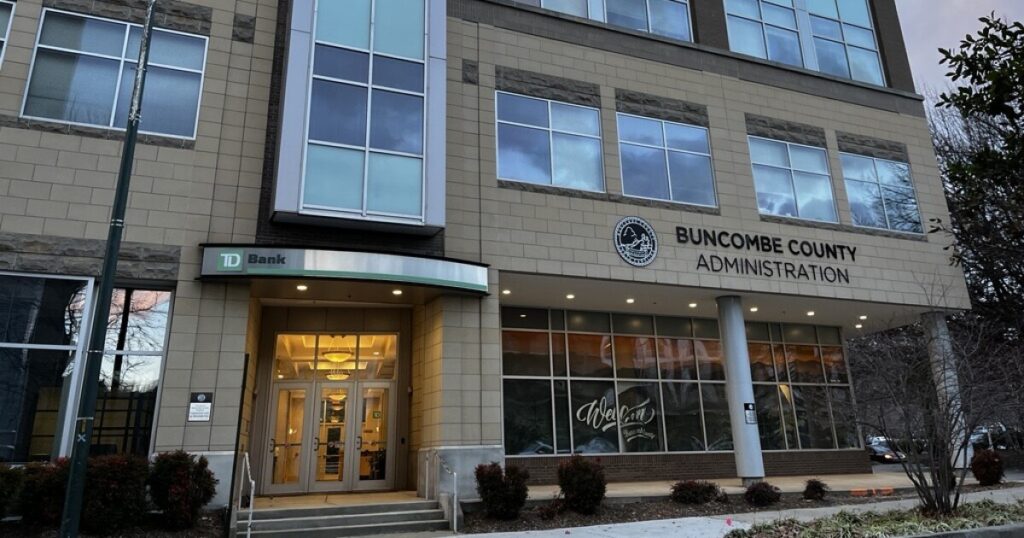
While Asheville’s city officials brace for significant reductions in community services, their counterparts in Buncombe County are charting a course for expansion in the upcoming fiscal year. Buncombe County officials discussed a substantial budget increase, hinting at growth amidst economic challenges.
The Buncombe County Board of Commissioners reviewed a preliminary budget for fiscal year 2026-27, presented during a work session on March 24. This budget outlines a proposed general fund expenditure of over $504 million, marking a 15% rise compared to the current $438 million budget.
Proposals include $4.4 million allocated for 37 new staff positions. County Manager Avril Pinder described this as “a conservative ask,” given the needs of the county. Initially, 86 new positions were requested, but the final proposal includes less than half of that number, as detailed in a list accessed through public records.
These new roles will span various county operations, including public-facing positions such as a security guard and social worker at the Pack Memorial Library, costing $205,000 annually. Other roles include a code enforcement team manager at $161,000 and two community paramedics at $158,000.
Two additional staff members, costing $242,000, will focus on developing the recently acquired 342-acre Deaverview parcel into a county park. Budget Manager John Hudson humorously remarked, “You may have heard that we bought a mountain.” These hires will help design the park’s landscape and programming.
Moreover, $4 million is earmarked for “community investments,” including $2.3 million for an affordable housing initiative and $1 million for nonprofit grants. Commissioner Terri Wells noted, “I think this is important funding,” reflecting on past budget cuts after Hurricane Helene.
With a recent property reappraisal, the impact on property tax rates remains uncertain. Even without changes to service levels, residents may encounter higher taxes.
Hudson pointed out that Buncombe is experiencing a 24.4% inflation rate over five years, the highest in decades. Global events like the COVID-19 pandemic, trade tariffs, and geopolitical tensions have exacerbated inflationary pressures. “Inflation has driven the costs — not only for consumers, but the county as well,” Hudson explained.
The county also faces the challenge of covering expenses previously funded by federal or state sources. This includes an estimated $2.8 million in administrative costs for the Supplemental Nutrition Assistance Program, $350,000 for the Asheville-Buncombe Air Quality Agency, and $82,000 for emergency foster care placements.
The next fiscal work session for Buncombe County is scheduled for Thursday, April 16, where revenue, healthcare costs, county fees, and the Asheville City Schools supplemental tax rate will be discussed.
For more details, watch the full recording and access related documents from the March 24 session.
City Budget Developments
Asheville City Council recently conducted a budget work session on March 24. The city anticipates $187 million in general fund spending for fiscal 2026-27, a 5.6% increase from the previous year.
Despite initially predicting a $30 million budget gap, the city has proposed service reductions, elimination of vacancies, and other measures to narrow the gap to $7.2 million. Strategies include using $1.9 million in one-time reserves for operating costs, a practice typically discouraged by budgeting experts.
Although city departments requested 38 new positions, budget recommendations include only two new roles, at an annual cost of $229,000, to oversee affordable housing and capital projects. The council is also considering adding 16 firefighters ($1.4 million) to alleviate the workload of current firefighters, which is crucial for maintaining morale and service quality, as emphasized by AFD members.
Asheville’s next fiscal work session is set for 2 p.m. on Tuesday, April 14, where final budget directions and discussions on enterprise funds and property tax rates will occur.
Access the full recording and related documents from the March 24 session.
Stay in the loop with The Asheville Explainer, BPR’s weekly newsletter for Asheville and Buncombe County.