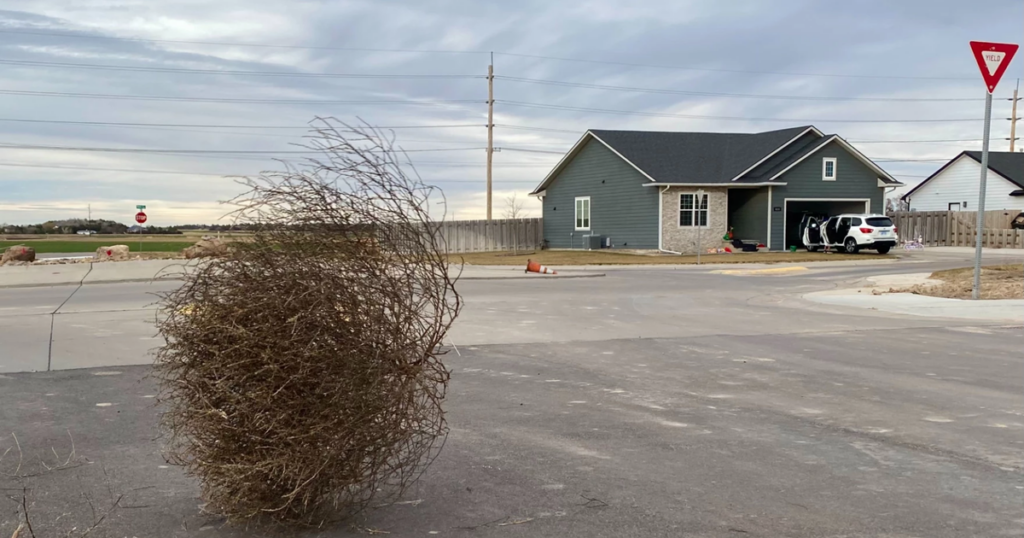
Tumbleweeds: A Risky but Cultural Element in Western Kansas
In the arid landscapes of western Kansas, tumbleweeds are more than just a common sight; they present a significant fire hazard. With their abundance of dry material, these rolling plants can quickly become a threat to fields and structures. Kirk recalls a particularly challenging instance when he assisted in removing large piles of tumbleweeds surrounding homes and yards. He described the experience, saying, “It literally inundated an entire neighborhood. We cleaned up that entire area and burned off all of those tumbleweeds over a period of probably a week.”
During years when tumbleweed proliferation is especially severe, the city provides “burn dumpsters”—trailers specifically designed to manage the disposal of these weeds. This initiative underscores the importance of managing tumbleweeds, as they significantly contribute to wildfire risks. After wet autumns, tumbleweeds flourish and disperse, only to dry out in time for the wildfire season, which typically occurs in late winter and early spring.
Kole Johnson of the National Weather Service in Dodge City highlights the collaborative efforts with fire officials to track the accumulation of dry weeds, which include tumbleweeds. According to Johnson, these weeds not only catch fire easily but can also propagate flames. “Tumbleweeds may ignite and then be blown elsewhere spreading the fire,” he noted, emphasizing their role in exacerbating fire spread.
Despite the challenges they pose, tumbleweeds maintain a place in the cultural fabric of western Kansas. They are sometimes used for decorative purposes, sold as unique souvenirs, or simply accepted as a characteristic feature of the landscape. Tumbleweeds have had some positive ecological impacts as well. Geier points out that they provide excellent habitats for certain bird species and serve as a food source for wildlife. “They make great habitats for some of our bird species. They produce a tremendous amount of feed for our wildlife. It’s part of growing up on the Great Plains,” Geier explained.
This story was originally produced by the Kansas News Service, a collaboration of KCUR, Kansas Public Radio, KMUW, and High Plains Public Radio.
This version is being distributed in partnership with Harvest Public Media, a collaboration of public media newsrooms in the Midwest and Great Plains. It reports on food systems, agriculture, and rural issues.