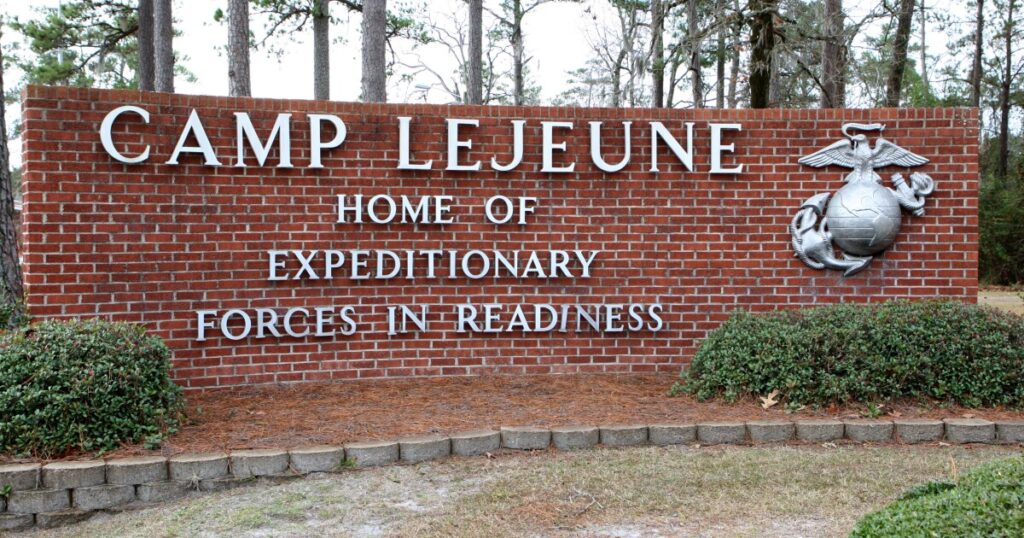
Decades after exposure to contaminated water at Marine Corps Base Camp Lejeune, numerous individuals are still awaiting resolution for their claims against the U.S. government. Despite legislation passed over three years ago allowing these cases to proceed, many remain stagnant in the legal system.
A civilian woman, who has chosen to remain anonymous, shares her personal experience linked to the toxic water. Her husband, drafted into the Marine Corps during the Vietnam War era, was stationed at Camp Lejeune in 1966 and 1967. The couple initially lived in trailers at Camp Geiger but eagerly moved to Tarawa Terrace, anticipating an improved living situation.
Tarawa Terrace, named after a significant WWII battle, was the base’s first post-war housing development. However, the Agency for Toxic Substances and Disease Registry disclosed that residents there from November 1957 to February 1987 were exposed to drinking water contaminated with tetrachloroethylene (PCE) due to a nearby dry cleaner.
The woman recalls experiencing prolonged illness during her pregnancy at Camp Lejeune, suspecting the toxic water as a potential cause. Additionally, her son faced feeding difficulties as an infant, raising concerns about the possible transfer of contaminants through breastfeeding.

Agency for Toxic Substances and Disease Registry
Her initial health claim was related to endometriosis, a condition linked to female infertility, diagnosed while she was the family’s primary breadwinner. Later, symptoms of multiple sclerosis emerged, but a definitive diagnosis took a decade to establish.
Information dissemination about the water contamination varied, with some residents learning through base newsletters in the mid-1980s, while broader notifications mandated by Congress began in 2008. This woman, however, discovered the connection through her daughter who found details online in 2010.

U.S. Veterans Administration
The Camp Lejeune Justice Act of 2022, part of the PACT Act, permits lawsuits against the U.S. government for illnesses linked to the base’s contaminated water from 1953-1987. However, navigating the claim process has been challenging. “Such a nightmare,” she described, detailing the complexities involved in filing a claim, which took months to complete.
As legal proceedings continue, with over 400,000 claims filed, ongoing hearings focus on the admissibility of expert testimonies and evidence of causation. Scheduled status conferences aim to address these issues further.

Benjamin Schachtman
/
WHQR
She expresses frustration over the burden of proof placed on those affected, stating, “With Tarawa Terrace, where we were, I don’t even understand why we’d have to prove anything. Just the address alone and the time of exposure alone, you’d think would be enough to qualify because it’s so well documented in the end after all these years, how terrible. this whole toxic pollution has been.”
Feeling neglected by the government and military, she laments, “The cruelty and disregard for the lives of the people who lived and worked there, it’s just it’s overwhelming to me.”
Her request for anonymity stems from concerns that her public statements might impact her compensation claim.